TL;DR:
The MEDDIC sales methodology is a B2B sales qualification framework that helps reps decide whether a complex deal is real, winnable, and worth pursuing before they invest a full sales cycle in it. It breaks qualification into six checkpoints and is most useful for high-value, multi-stakeholder enterprise deals.
- MEDDIC stands for Metrics, Economic Buyer, Decision Criteria, Decision Process, Identify Pain, and Champion.
- It is a qualification framework, not a sales process. It tells you which deals deserve your time, not how to run the conversation.
- A sales team at PTC created it in 1996. Dick Dunkel, Jack Napoli, and John McMahon are credited with building and spreading it, and it helped PTC grow from $300 million to $1 billion in four years.
- The economic buyer and champion are where deals die. Reps often mistake an enthusiastic contact for the real budget holder or internal advocate.
- MEDDICC adds Competition. MEDDPICC adds Competition and Paper Process. Longer acronyms fit larger, more complex enterprise deals.
- MEDDIC works best for complex, long-cycle deals, while BANT suits fast transactional sales and SPIN handles discovery. SPIN and MEDDIC pair well together.
- The framework fails on bad data. Perfect qualification means nothing if the contact details for your economic buyer are wrong or out of date.
- Score each element on evidence, not optimism, and reinforce it inside your CRM to stop adherence from decaying after training.
It's week eight of a deal you swore would close this quarter. Your champion stopped replying. Procurement just dropped a security review nobody mentioned. And the "economic buyer" your contact introduced you to? She can recommend, but she can't sign.
You didn't lose this deal in week eight. You lost it in week two.
That's the gap the MEDDIC sales methodology was built to close. It forces you to ask the hard qualifying questions early, while you still have time to act on the answers. I've watched reps skip that work to feel busy, then act shocked when a "sure thing" evaporates. The framework won't make a bad deal good. But it tells you fast whether a deal is real, who controls it, and what it takes to win.
Here's how it works, where it falls apart, and how I run it on live deals.
What the MEDDIC sales methodology actually is
MEDDIC is a qualification framework for complex B2B sales. Six elements, one job: figure out if a deal is worth your time before you sink a quarter into it. It sits inside your wider B2B sales process, not on top of it.
A sales team at PTC (Parametric Technology Corporation) built it back in 1996. Dick Dunkel, Jack Napoli, and John McMahon get the credit for creating, documenting, and spreading it. They studied which deals PTC won and which it lost, and they kept finding the same six factors behind the outcome. So they turned those six factors into a common language and baked it into onboarding for every new rep.
The results were hard to argue with. PTC grew from $300 million to $1 billion in revenue in four years, and MEDDIC was the engine underneath that run.
Here's a distinction most guides skip. MEDDIC is a qualification framework, not a sales methodology. A methodology like SPIN or Challenger tells you how to run the conversation. Qualification tells you which deals deserve the conversation. I think conflating the two is why so many teams "do MEDDIC" and feel like nothing changed. They bolted vocabulary onto a broken pipeline and called it strategy.
What each letter in MEDDIC stands for
Six letters. Each one answers a question that, left unanswered, can quietly kill your deal. Run them as a checklist you revisit through the deal, not a one-time form you fill out and forget.
Metrics
Metrics are the numbers your buyer needs to move. Not your features. Their results. So you ask something like: if this works, what number on your dashboard changes in 12 months? The trap here is reaching for your own ROI math. Your slide says "30% efficiency gain," but their CFO has never seen that figure. Tie the value to a metric they already report on, or your contact can't sell it upward.
And if nobody can name a metric at all? You don't have a deal. You have a demo request.
Economic Buyer
The economic buyer is the one person who can say yes when everyone else says no. They own the budget. Usually a VP or someone in the C-suite on enterprise deals.
Try this on an early sales discovery call: "If you and I agree this is the right move, is there anyone else who'd need to approve the spend?" That flushes out the real signer fast. Reps get burned here constantly. They treat an excited director as the buyer, then meet the VP of Finance for the first time in month three, after the deal's already stalled.
Decision Criteria
Decision criteria are the boxes your buyer checks before picking a vendor. Technical requirements. Budget thresholds. Security standards. Whatever sits on their internal scorecard.
Find out by asking what the three biggest factors are when they compare options, then build your pitch around those three instead of your favorite features. Skip this and you're guessing. Guessing against a competitor who took the time to learn the criteria is how good products lose.
Decision Process
Every step between "we like it" and "it's signed" lives here. Who reviews it, who approves it, and what order it all happens in.
The question that opens it up: walk me through what happens after we agree, and who else touches this before it's final. Most reps assume they already know the answer. They don't, and the gap is where a surprise legal review or board sign-off torpedoes the deal in the final week. In enterprise accounts you're really mapping the whole B2B buying group, not one person's calendar.
Identify Pain
Pain is the business problem pushing the buyer to act now. No real pain, no urgency. No urgency, no deal this quarter.
A good gut-check question: what happens if you do nothing and this stays the same six months from now? If the answer is a shrug, the pain isn't real. A lot of what reps log as "pain" is mild annoyance, and annoyance never gets budget approved. Strong, quantified pain is what turns a contact into a real sales qualified lead instead of a polite tire-kicker.
Champion
Your champion is someone inside the account with real influence who wants you to win. Not a friendly contact. An advocate who sells for you when you're not in the room.
The honest test is whether this person would spend their own political capital pushing your deal. If they won't, you have a coach, not a champion. The fake champion is the priciest mistake in the whole framework. They take your calls, sound enthusiastic, feed you information, and have zero pull internally. You walk away feeling qualified. You aren't. Disciplined champion tracking inside your deals is what tells the two apart before you've bet a quarter on the wrong one.
MEDDIC vs MEDDICC vs MEDDPICC
The acronym shows up wearing extra letters, and the difference confuses a lot of people. The longer the acronym, the more complex the deal it's built for. Here's the breakdown.
Roughly 73% of B2B SaaS companies with deals over $100K ARR run some version of this framework, and full adopters report deal sizes up about 24% with win rates up around 18%, according to MEDDPICC enterprise adoption benchmarks. At that deal size, the extra rigor earns its keep.
But I'll say something a little contrarian. Most teams add letters before they earn them. They jump to MEDDPICC because it sounds more serious, then drown reps in fields nobody fills out. If your average deal closes in 30 days with one signer, you don't need a Paper Process column. Start simple. Add complexity when the deals demand it, not when a training deck suggests it.
MEDDIC vs BANT and SPIN: which framework fits
MEDDIC isn't the only qualifier out there, and it isn't always the right one. Two questions decide the fit: how complex is the deal, and how many people sign off.
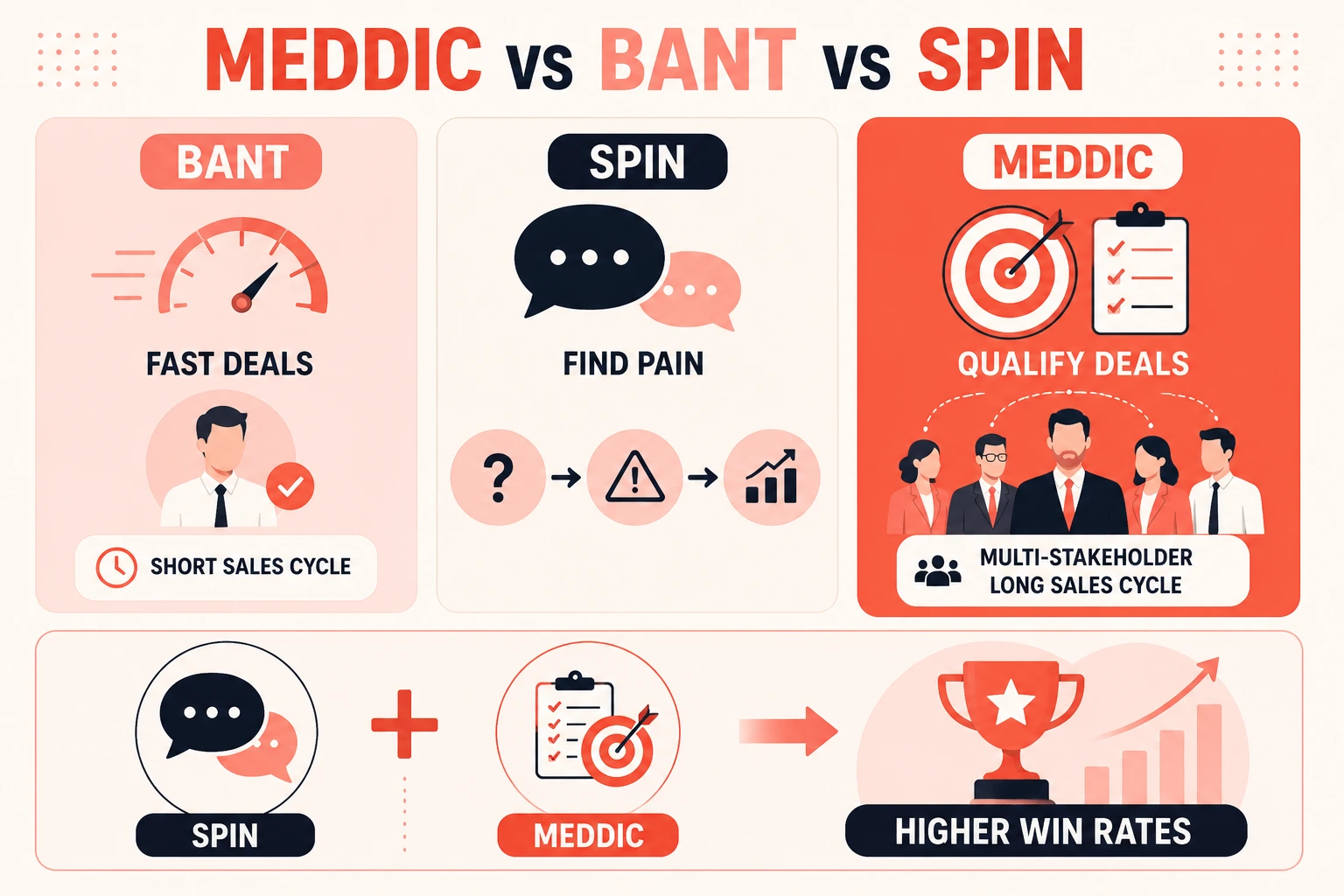
- BANT (Budget, Authority, Need, Timeline) is the fast, lightweight option. Good for transactional, short-cycle deals under roughly $10K and high-volume inbound. It's shallow on purpose. It skips champions and decision process entirely, so it gets you in trouble on complex deals where unseen buyers block you late.
- SPIN (Situation, Problem, Implication, Need-payoff) is a questioning method for discovery, not a qualifier. It helps you uncover and deepen pain.
- MEDDIC is the heavyweight for complex, multi-stakeholder, long-cycle deals.
Here's the part smart teams understand: these aren't rivals. SPIN selling and MEDDIC pair beautifully. Use SPIN-style questions to run the discovery, then MEDDIC to grade whether the deal is real. One handles the conversation, the other handles the verdict. Teams that combine the two report meaningfully higher win rates than teams running either alone.
Why MEDDIC works (the upside)
When a team runs MEDDIC with discipline, three things change.
- Cleaner pipeline. Reps disqualify bad fits early instead of dragging dead deals to the forecast. Less time wasted on prospects who were never going to buy.
- Sharper forecasting. When you actually know the economic buyer, the criteria, and the process, you can predict timing and likelihood with far less guesswork. Forecast variance tightens dramatically.
- A shared language. "What's the metric? Who's the EB? Is the champion real?" becomes how the whole team inspects deals. Managers coach faster. Reviews stop being vibes-based.
Where MEDDIC breaks (and nobody warns you)
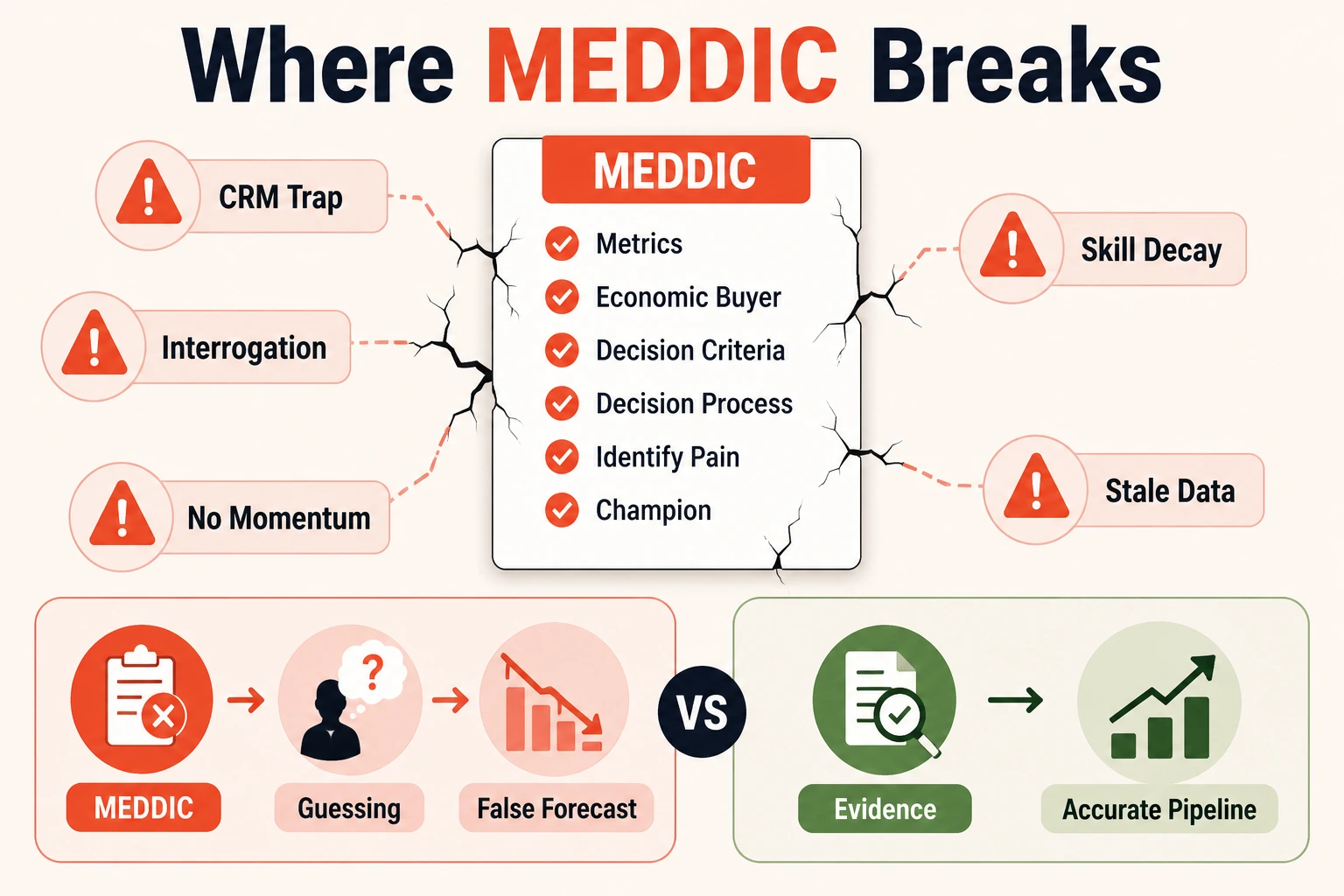
The framework is sound. The way teams run it usually isn't. Here are the failure modes I see most.
The CRM checkbox trap
Reps fill in "Champion: Sarah" because the field needs a value, not because Sarah will fight for the deal. Managers read those fields back in pipeline reviews like scripture. Nobody actually qualified anything.
The fix is simple and uncomfortable. Score each letter 1 to 3 on evidence, not optimism. "Champion" isn't filled in until you can name a moment Sarah pushed for you internally.
The interrogation problem
Poorly trained reps treat MEDDIC like an interrogation. They machine-gun questions at the buyer: who's your economic buyer, what are your decision criteria, who's your champion. It feels like a deposition, and it kills trust. The skill is weaving these questions naturally into a real conversation. That takes practice, not a one-day workshop.
It's a late-stage tool, not a momentum engine
MEDDIC is great at inspecting a deal. It does almost nothing to create one. It won't generate urgency in a low-momentum deal or tell you why a buyer started looking. Lean on it too early and you'll have a beautifully qualified opportunity with no energy behind it. Pair it with a discovery method that builds the case for change.
Skill decay
Even teams that spend serious money on training, sometimes hundreds of thousands of dollars, lose 40% to 50% of their process discipline within six months unless the framework lives inside the CRM and tracks itself. That MEDDIC training adherence research is well documented. Reps drift back to gut feel. The fix is automation and reinforcement in the flow of work, not another slide deck.
Stale data quietly kills it
Here's the part the training decks skip entirely. MEDDIC assumes you're talking to the right people. It says nothing about whether you can actually reach them.
Run flawless qualification on a contact whose number is three jobs out of date, and the framework still grades the deal as healthy. Garbage in, confident forecast out. Poorly qualified pipelines drag, too. Deals that end up closed-lost often take roughly twice as long to crawl through early discovery as the ones you win, a sales cycle efficiency study found, burning weeks on fits that were never real. Tight early qualification is what strips those out.
How to roll out MEDDIC without killing rep morale
Don't boil the ocean. Dump all six elements on the team with mandatory CRM fields on day one and reps will treat it like compliance and quietly hate you.
- Start with two letters. For most teams that's Economic Buyer and Champion, because that's where deals die. Score them on evidence.
- Run a weekly deal review where the only question is "what's your proof?" Not "is the field filled in."
- Add the rest later, once the first two stick.
- Automate the reinforcement. Surface MEDDIC prompts inside the tools reps already live in, so qualification happens during the deal, not from memory after the call.
What to do: Pick your two weakest qualification points. Make those the only fields reps must defend with evidence this quarter. Expand once they're habit.
Where SMARTe fits
I'll be honest about this, because overselling it would be the wrong move. SMARTe doesn't replace MEDDIC. It fixes the assumption MEDDIC quietly depends on: that you can reach the people the framework points you toward.
Think about the economic buyer step. MEDDIC tells you to get in front of the VP of Finance who signs. It can't dial the phone for you. If that VP's direct dial is wrong or three jobs stale, your qualification is just tidy notes on a deal you can't move.
That's the gap SMARTe closes:
- 289M+ verified B2B contacts so the economic buyer you need to reach is actually in the data.
- 75%+ US mobile and direct dial coverage so "reach the right person" turns into a connect, not a voicemail. Accurate B2B direct dials are the difference between a live conversation and a dead end.
- Real-time verification so the contact is fresh at the moment you call, not whenever the list was last scraped.
- 66M+ company profiles and buying group mapping so you map the full decision process instead of guessing who else is in the room.
A great framework on bad data is still a wasted quarter. Qualification tells you who to reach. SMARTe makes sure you can.