Most CRMs are full of half-finished leads.
A name. A company. An email that bounces. A job title that's two roles out of date. Your reps know this problem. They open a lead record, see that 60% of the fields are empty or wrong, and spend the next 20 minutes piecing together a complete picture before they can write the first line of outreach.
According to HubSpot's 2024 Sales Trends Report, sales reps already spend less than two hours per day actually selling. The rest goes to exactly this: research, data hunting, admin. A significant chunk of it comes down to incomplete lead data that never got properly enriched.
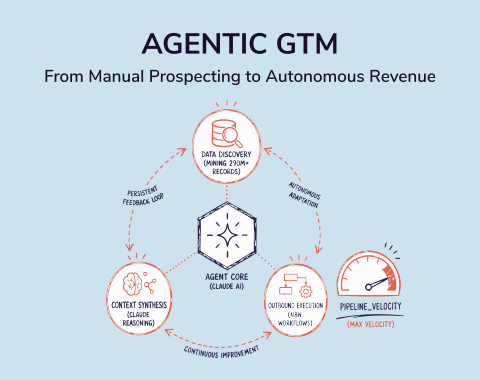
Claude for lead enrichment changes what that loop looks like. Connected to SMARTe MCP, Claude gets real-time access to 289M+ verified contacts, direct dials for 75%+ of US decision-makers, technographic data, and Bombora intent signals. Instead of opening four tabs to piece together a lead profile, you describe what you need and Claude pulls verified, enriched data directly inside the conversation.

SMARTe GTM Intelligence
Start Smarter Prospecting Today
What Lead Enrichment Actually Is — And Why Most Teams Still Get It Wrong
Lead enrichment is the process of taking an incomplete lead record and filling it with the data your team actually needs to make a decision. A name and email alone tells you almost nothing about whether someone is worth pursuing. Enriched, that same contact tells you their exact role, the size and funding stage of their company, what technology they run, whether they've been actively researching your category, and whether they're even still at that company.
Most teams understand this in theory. In practice, they skip it because it's slow and expensive done properly. They run a list through a single tool, get partial coverage, and decide half-enriched data is good enough.
It isn't. Research from Surfe found that teams investing in proper lead enrichment close deals 30% faster and see up to 25% better conversion rates. That gap comes from better prioritization and better personalization. Both start with complete, current data.
What B2B data enrichment actually adds to a lead record falls into five categories:
- Contact data — verified work emails, direct dial phone numbers, mobile numbers. The basics, done right.
- Firmographic data — company size, industry, revenue tier, funding stage, geography. Tells you whether the account belongs in your ICP before a rep touches it.
- Technographic data — what tools and platforms the company actually uses. Changes how you position outreach entirely.
- Intent signals — buying signals like funding rounds, leadership changes, headcount growth, and category-level intent from platforms like Bombora. Tells you timing, not just fit.
- Job change data — tracks when a contact moves to a new company or takes a new role. (Some of the best outbound opportunities come from champions landing at new accounts. This is the signal most teams forget to enrich for.)
I think most SDR teams focus too much on the first category and too little on the last three. A verified email is a dial tone. Intent data and technographics are the reason to actually pick up the phone.
The Two Variables That Kill Outbound: Coverage and Freshness
Most conversations about bad lead data focus on accuracy. That's the wrong frame. In my experience, the two variables that quietly kill outbound performance are coverage and freshness, and they're different problems with different fixes.
1) Coverage is how much of your list a provider can actually fill. No single data source has complete coverage across every geography, company size, industry, and seniority level. A provider might cover 65% of your North American enterprise contacts and drop to under 30% for mid-market contacts in APAC. That gap isn't just missing fields. It's pipeline your reps are walking past because they have nothing to work with.
2) Freshness is how recently the data was verified. B2B data decays at roughly 20 to 30% per year. In fast-moving sectors like tech, some estimates put it at over 2% per month. People change jobs. Companies get acquired. Email domains shift. A contact verified six months ago might already have a different employer, a different role, and a different email address. Sending to stale data doesn't just waste a rep's time. It damages your sender reputation when those emails bounce, which hurts every campaign you run after it.
Waterfall enrichment addresses the coverage problem by querying multiple data sources in sequence, stopping only when a verified result is found. Real-time verification addresses the freshness problem by checking data at the moment it's pulled, not hours or days before it reaches your list. You need both to run enrichment that actually moves pipeline.
What Claude for Enrichment Actually Means
Claude on its own is a reasoning engine. A very good one. It can qualify leads, score ICP fit, draft personalized outreach, and process structured data with precision. What it cannot do, without a data connection, is find verified contact information. It has no live access to B2B databases. It can't look up a mobile number, pull a company's current tech stack, or flag that an account raised a Series B last week.
That's the problem Model Context Protocol (MCP) was built to solve.
MCP is an open standard Anthropic released in late 2024. It's the bridge between Claude and external tools, databases, and live data sources. Think of it as giving Claude a direct line into the world outside its training data. Connect an MCP server and Claude can read from live databases, write back to your CRM, pull current contact records, and take real action in your existing workflow — not just reason about data in a chat window.
SMARTe MCP is the data layer that makes Claude's enrichment capability real.

Connect it and Claude gets live access to SMARTe's full verified database: 289M+ contacts, 66M+ company profiles, technographic signals across 64K+ products, and Bombora intent data. All in real time. Not a batch export from last night. Verified at the exact moment Claude pulls the record. That distinction is what keeps bounce rates low and connect rates up.
For context on where SMARTe MCP sits in the broader stack, the best MCP servers for B2B sales covers the full ecosystem by use case.
Connecting SMARTe MCP to Claude
Setup takes a few minutes. For Claude.ai, navigate to Settings, then Connectors, and add SMARTe as a new MCP connector.
If you're running enrichment jobs in Claude Code, add an enrichment block to your CLAUDE.md file. This gives Claude persistent context about your data standards across every session:
One honest note: SMARTe MCP handles the data layer. It won't define your ICP or tell you which accounts to target. That judgment still belongs to you. What changes is that the moment you describe what you need, Claude pulls it from a live, verified database instead of leaving your rep with four open tabs and a spreadsheet.
What SMARTe MCP Gives Claude Access To
This is where enrichment stops being abstract and starts being a workflow. Here's what Claude can actually pull through SMARTe MCP, and why each data type changes the outbound equation differently.
Verified Emails for 86% of US Decision-Makers
Email is the baseline of any outbound motion. SMARTe covers verified emails for 86% of US decision-makers, with verification happening in real time at the moment Claude requests the data. Not a confidence score from a nightly batch run. An SMTP check that confirms the address is live right now.
For teams running high-volume AI data enrichment, the difference between real-time and batch verification shows up directly in bounce rates. Anything above 2 to 3% starts damaging your sender domain. Stale verified data compounds that risk quietly until a campaign suddenly craters.
Sample prompt for email enrichment:
"For each contact in my file, find their verified work email using SMARTe. Return only addresses that have passed real-time verification. Add columns: verified_email, confidence_score, verification_status."
Direct Dials and Mobile Numbers That Actually Connect
Phone coverage is where most data providers fall apart. The number looks verified. The rep dials. It routes to a reception desk or a main switchboard or a number that was disconnected six months ago.
I think direct dial coverage is the most underreported enrichment metric in outbound. SMARTe's US direct dial coverage runs at 75%+, global at 50%+. Those are direct lines and mobile numbers specifically, not company mainlines. (The connect rate difference between a real direct dial and a switchboard is roughly 3 to 4 times. So the type of phone number matters as much as having any number at all.)
For any team running multi-channel outbound, B2B direct dials at this coverage level means most contacts your reps call will actually reach the person rather than routing through a gatekeeper.
Sample prompt for phone enrichment:
"For the contacts in my file, find their direct dial or mobile number using SMARTe. Filter out switchboards and generic company lines. Add: phone_number, phone_type, confidence."
Firmographic Data Across 66M+ Company Profiles
Contact data without company context is half the picture. Firmographic data is what tells you whether an account belongs in your pipeline before any rep invests time in it.
SMARTe covers firmographic data for 66M+ company profiles across 200+ countries, including employee count, revenue signals, funding stage, industry vertical, and headquarters location. These are the fields that power ICP scoring logic and tell your AE whether this is a five-figure deal or a six-figure deal before they spend an hour on a discovery call.
Firmographic data in your enrichment workflow serves one clear purpose: ruling out the accounts that will never convert before you spend credits enriching contacts there.
Technographic Signals Across 64K+ Products
Knowing what tools a company actually uses changes every conversation you start. It changes your subject line. Your opening sentence. Whether you lead with competitive displacement or stack compatibility.
SMARTe tracks technographic data across 64K+ products — CRM, sales engagement platforms, marketing automation, analytics, developer infrastructure, and more. (That's not just the obvious tier-one software. It covers the full stack picture most data providers only partially capture.)
For technographic segmentation that drives actual personalization, this is the signal that separates a sequence built around a prospect's real setup from one that sends the same generic opener to everyone.
Bombora Intent Signals for Timing
Firmographic fit tells you an account belongs in your pipeline. Buying signals tell you when to reach out.
A VP of Sales at a 200-person SaaS company fits your ICP. The same VP whose company raised a Series B three weeks ago, hired four SDR managers in the last 60 days, and has active Bombora intent on "sales intelligence" is a call you make today. Both have the same firmographic score. Only one has an open window.
SMARTe MCP includes Bombora intent data natively — no separate integration required. Intent signals, funding events, and leadership changes come through the same MCP connection alongside contact and company data, in a single enrichment session.
This is what separates enrichment that identifies fit from enrichment that identifies timing. For buying signals to be actionable, they need to be current. A signal from six weeks ago is history. One from today is a reason to call this afternoon.
The Full Enrichment Workflow in One Session
Here's what the complete workflow looks like with Claude and SMARTe MCP running together.
- Start with your raw input. Paste a contact list, name target accounts, or describe your ICP in plain English. Claude validates the input first — removing duplicates, flagging records with missing required fields, normalizing company names and domains. Bad input gets caught here, not after you've spent credits on it.
- Run contact enrichment. Claude calls SMARTe for verified emails and direct dials. Records that come back verified move forward. Those without a verified contact get flagged for manual review rather than silently dropped.
- Layer in firmographics. For each unique company domain, Claude pulls employee count, revenue tier, funding stage, industry, and geography. These fields feed directly into ICP scoring.
- Pull the tech stack. Claude retrieves technographic data for each account — what's in the CRM slot, the marketing automation slot, the sales engagement slot. Which of those tools is a competitive signal and which is a compatibility hook.
- Add intent signals. Bombora intent and live buying signals come through the same connection. Accounts actively researching your category get flagged for priority outreach.
- Score against ICP and export. Claude scores each lead against your ICP criteria from the CLAUDE.md config, sorts by fit, and produces a clean output with every enrichment field appended — ready to push into your CRM or sequencing tool.
A single prompt that runs the full chain:
"Take leads.csv. Run full enrichment: 1) validate and deduplicate by domain plus full name. 2) Find verified emails and direct dials via SMARTe. 3) Pull firmographics for each unique domain. 4) Retrieve tech stack data. 5) Flag accounts with active intent signals. 6) Score each lead against my ICP. 7) Export as leads-enriched.csv sorted by ICP score descending. Flag contacts missing verified contact data."
This is SMARTe's B2B data enrichment running as a single AI session — not a three-hour manual process across disconnected tools.
What Enriched Data Enables Downstream
The value of enrichment isn't the data itself. It's what the data makes possible further down the pipeline.
1) Lead scoring stops being a guessing game. Points-based models treat every signal as independent. A company with matching firmographics and active intent signals on your category fires the same score as the same company with no intent data, no buying triggers, and no recent activity. Claude reasons across all of it together — not as separate checkboxes but as a full picture. That's how you identify the 40 accounts worth calling this week inside a list of 500 that all technically fit your ICP.
2) Personalization becomes real. Most "personalization" in outbound is a first name and a company name. Actual personalization means knowing a company hired four new SDR managers last quarter and opening with that. Knowing they run a specific CRM and positioning around it. Sales prospecting strategies that use technographic and intent signals consistently outperform generic sequences, and the gap gets wider as your ICP gets more specific.
3) CRM hygiene stops being a project. CRM data enrichment at scale usually means a quarterly RevOps initiative someone has to manually schedule, run, and QA. With SMARTe MCP connected to Claude, re-enrichment becomes a prompt you can run on your whole database, a specific segment, or every new contact as it enters your CRM. According to Gartner, poor data quality costs B2B companies an average of $12.9 million per year. The bulk of that is wasted outreach, manual rework, and deals that stall because reps were working from bad records.
Five Enrichment Mistakes That Quietly Kill Pipeline
1. Enriching before ICP filtering
If you enrich 5,000 contacts and filter down to 800 that match your ICP afterward, you've spent credits on 4,200 contacts who were never going to convert. Filter by ICP criteria first. Enrich only the contacts at accounts that actually qualify. Claude can run both steps in the same session, in sequence.
2. Treating email verification as a separate step
Verification is part of enrichment, not something you run after. Finding an email and verifying it six hours later introduces a gap. Addresses change. Domains go offline. Real-time verification at the point of enrichment is what keeps bounce rates below 2%. Anything above 3% starts damaging your sender domain in ways that are slow to recover.
3. Running enrichment once and walking away
B2B data doesn't stay accurate. A contact enriched in Q1 may have changed employers by Q3. An account you scored high on firmographics may have been acquired since. AI-ready B2B data is not a one-time project. It's a continuous system. The teams with CRMs their reps actually trust are running re-enrichment cadences, not hoping last quarter's batch is still good.
4. Stopping enrichment at contact data
Verified email plus verified phone is the floor, not the ceiling. The technographic and intent signals are what separate a name on a list from a warm opportunity. If your enrichment workflow stops at contact fields, you're getting the dial tone. You're missing the reason to call.
5. Leaving enriched data in a spreadsheet
Enriched data sitting in a CSV only helps the person who ran the enrichment session. Push it into your CRM immediately, with clean field mapping, so every rep and every downstream workflow benefits. The 1-10-100 rule of data enrichment applies: it costs $1 to verify data at entry, $10 to correct it later, and $100 to deal with the consequences of bad data in your pipeline. Enrich right the first time and sync it back automatically.
The Real Point
The teams I've seen convert at higher rates aren't the ones with better sequences or smarter copy. They're the ones who reach the right person, with the right context, before the window closes.
Enrichment is what builds that context. Claude is what reasons across it. SMARTe MCP is what makes the data real-time and verified enough to actually act on rather than just interesting to look at.
A McKinsey report found that 67% of organizations using AI in sales and marketing saw revenue growth in the prior 12 months. The ones that didn't were mostly running AI on top of incomplete, stale data. The data layer is what determines whether the reasoning matters.
Try SMARTe free — no credit card required — and connect it to Claude. Run your first enrichment session. See what verified, real-time data actually changes about the leads your team is working.
.png)