TL;DR:
A customer acquisition funnel is the path a buyer takes from first hearing about you to becoming a paying customer. It runs through five stages: awareness, interest, consideration, conversion, and retention. Marketing owns the top, sales owns the bottom, and the handoff between them is where B2B revenue quietly disappears.
- The five stages: awareness, interest, consideration, conversion, retention.
- CAC payback is the metric that matters, not lead volume. The median B2B SaaS company takes about 16 months to earn back what it spent winning a customer.
- B2B funnels carry a buying group, not a buyer. Forrester counts 13 internal stakeholders on a typical decision, plus nine outside influencers.
- Find your worst stage first. Stage conversion rate tells you which one it is, in about an hour.
- Retention belongs inside the funnel. A customer who leaves in month six never paid you back.
Two companies can run the same customer acquisition funnel and end up in different businesses.
One recovers its acquisition spend in seven months and reinvests. The other takes twenty-four months, calls it growth, and raises another round to cover the gap.
The difference almost never sits at the top. Both companies can generate traffic. Both can book meetings. What separates them is how much of that early volume survives the middle. And whether anyone can name the stage where it stops surviving.
I've watched teams answer a soft quarter by doubling ad spend. Sometimes it works. Usually it just makes the leak more expensive.
So let's start with what the funnel is, then get to the part where you find your leak.
What Is a Customer Acquisition Funnel?
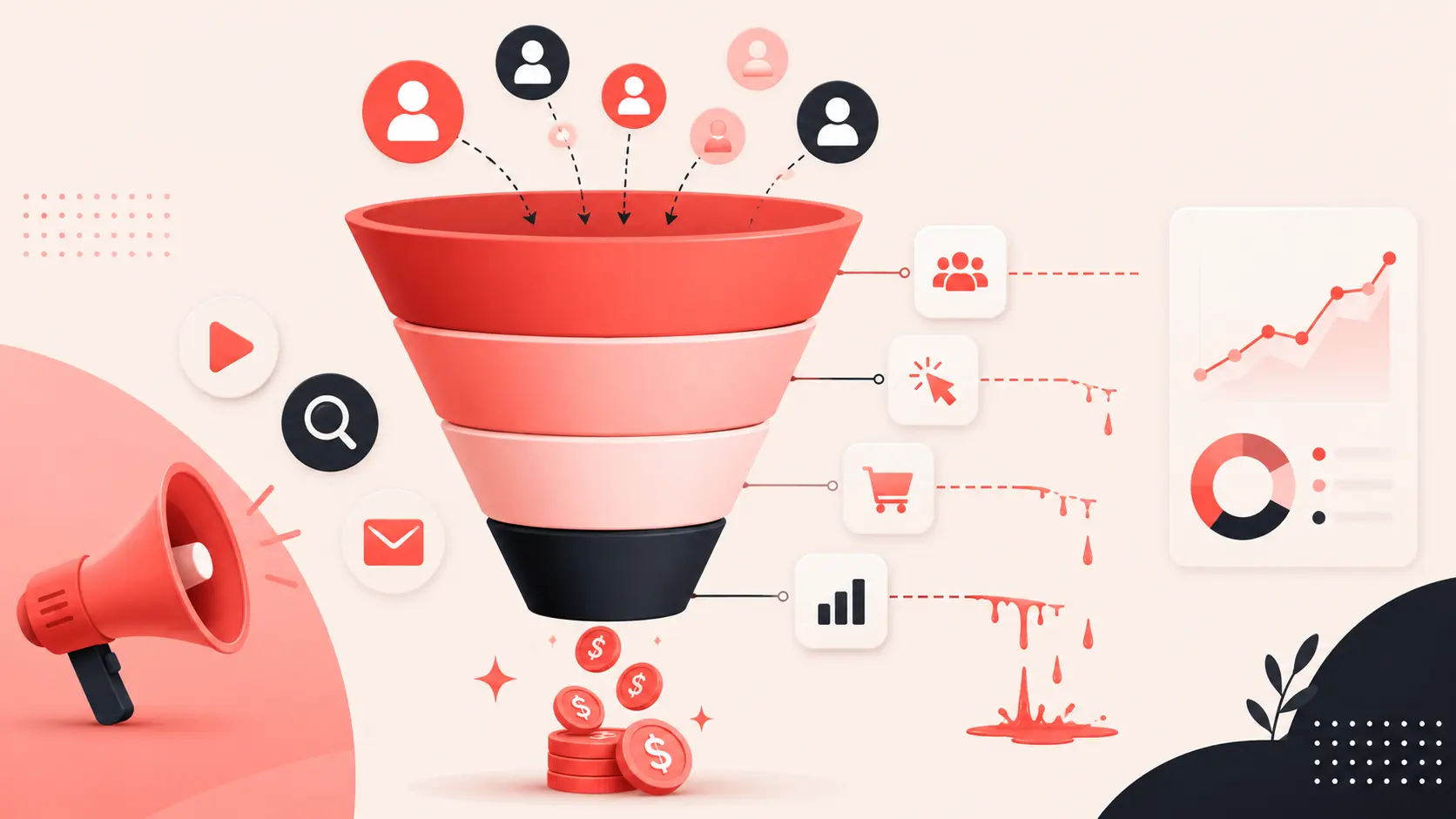
A customer acquisition funnel is a model of how strangers become customers. The model splits that path into stages, so you can count how many people enter each one and how many reach the next.
The shape gives it the name. Lots of people at the top, a handful at the bottom.
Take a B2B software company. Ten thousand people read a blog post this quarter. Four hundred download something. Ninety book a demo. Twenty-two sign. That's a funnel, and every one of those drop-offs is a number you can work on.
How the funnel works
Each stage has three parts worth tracking:
- Entry: how many people or accounts arrived
- Exit: how many moved forward
- Drop-off: the gap between those two numbers
Divide exits by entries and you get a stage conversion rate. That number turns a diagram into a diagnostic tool. Without it you have a picture on a slide.
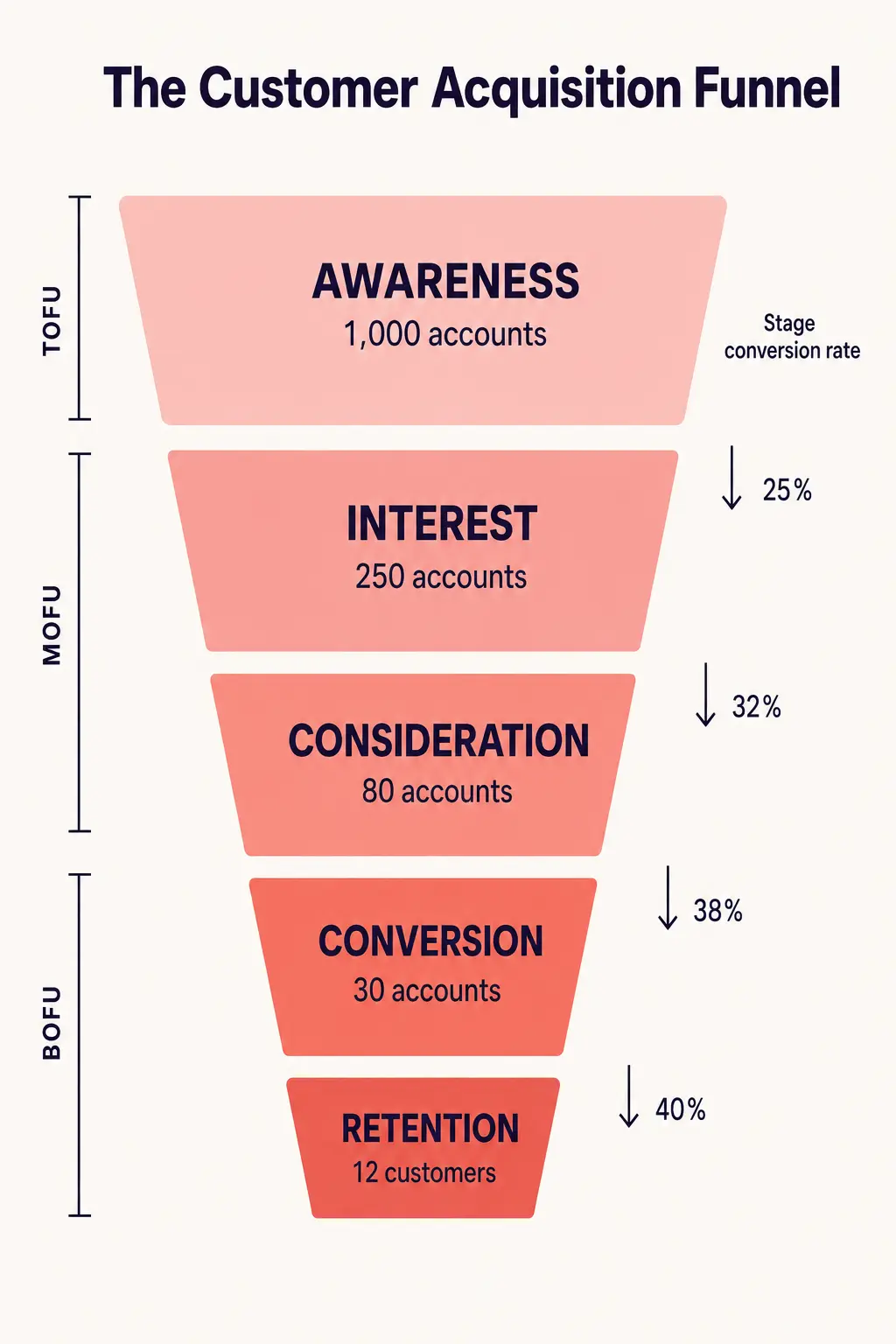
Marketers often split the funnel into three zones instead of five stages. Top of funnel (ToFu) is where people are still discovering the problem. Middle of funnel (MoFu) covers research and comparison. Bottom of funnel (BoFu) is the decision. Same path, lower resolution.
Why B2B funnels behave differently
Consumer funnels move one person through one decision. B2B funnels move a committee.
Forrester's State of Business Buying, 2026 puts the typical purchase at 13 internal stakeholders plus nine external influencers. Those 22 people don't move through your funnel together. Your champion may be comparing pricing while the CFO has never heard your name and security hasn't joined yet.
Gartner adds a second complication. Its research on the B2B buying journey finds that 75% of buyers would rather buy without talking to a rep at all. Much of your funnel therefore runs without you in the room, on review sites and in Slack groups you'll never see.
What this means in practice: track accounts, not email addresses. One person clicking twice looks identical to two people clicking once, and only one of those tells you a deal is warming up.
Which explains a confusion worth clearing up.
Customer Acquisition Funnel vs Sales Funnel vs Marketing Funnel
These three overlap, which is why teams argue past each other in pipeline meetings. The clean way to separate them is by where each one starts and stops.
The demand generation funnel is the marketing half. The B2B sales funnel is the sales half. The acquisition funnel spans both, which is exactly why it catches problems the other two hide.
Here's the practical case for using it. Marketing reports 400 MQLs. Sales reports a 22% win rate. Both teams hit target, and the company still loses money on every customer. Only the acquisition view, which divides total spend by customers won, shows you that.
One more distinction worth making. The acquisition funnel is your internal model of the process. The customer journey is the buyer's lived experience of it, which is messier and rarely linear. You need both, but they answer different questions.
Now to the stages themselves.
The 5 Stages of the Customer Acquisition Funnel
Different sources count four, five, or six stages. The five below are what tools and teams have standardised on. Learn these.
Stage 1: Awareness
The buyer knows something hurts. They don't know your category exists yet.
Their searches read like symptoms. "Why do our cold emails bounce" rather than "email verification software." Content that targets the category term alone will not reach them, because they haven't learned the term yet.
What to do: Write for the customer pain points people describe out loud, in their words. A post that names the symptom lets you frame the problem first. Whoever frames the problem tends to define the shortlist criteria later.
Stage 2: Interest
Now they know the category and they're reading. Comparison posts, peer recommendations, a few questions put to an AI assistant.
You have close to zero visibility here. Nobody fills in a form while they're still reading.
Two sources give you partial sight. Third-party intent data shows which accounts are consuming content in your category. Site visitor identification shows which companies visited without converting. Both return accounts rather than names, which is fine at this stage.
Interest stages run long in B2B. A lead nurturing strategy that stays useful without pestering people is what keeps you on the list while they take their time.
Stage 3: Consideration
Three to five vendors go on a shortlist. Everyone else stops existing for this deal.
Shortlists get built from G2 reviews, peer referrals, past experience, and whatever the AI answer surfaced. Advertising has limited effect at this point because the buyer has already narrowed the field.
The customer touchpoints that matter here sit almost entirely outside your control. What you can control is whether you noticed. Watching buying signals across an account closes part of that gap. Pricing page visits, competitor comparison activity, and hiring in a relevant function all point the same way. They tell you an account is shortlisting before any form arrives.
What to do: Publish real pricing. I think hidden pricing costs more deals than it protects. Buyers who cannot find a number quietly drop you rather than ask, and you never learn it happened.
Stage 4: Conversion
Demos, trials, security review, procurement, legal. The buying group finally becomes visible to you here. It's also the stage where deals stall.
A stall rarely means the buyer went cold. Usually one stakeholder you never spoke to raised an objection in a meeting nobody put on your calendar. Forrester found 86% of B2B purchases stall at some point in the process.
What to do: Count named contacts on every open deal. Fewer than four in a long B2B sales cycle is a coverage problem. Coverage problems look exactly like timing problems until the deal dies.
Give your champion a business case they can forward without editing. Not a deck. One page, in plain language, with the numbers already filled in.
Stage 5: Retention and Expansion
Plenty of funnel diagrams stop at the signature. That's a bookkeeping choice, and an expensive one.
If your CAC payback is 16 months and a customer leaves in month six, you did not acquire that customer. You rented them at a loss. Which is why B2B customer onboarding belongs inside the acquisition funnel rather than in a separate post-sale process nobody measures.
The first 60 days also set the ceiling on customer expansion revenue. Accounts that reach first value quickly buy more seats later. The ones that stall in onboarding rarely expand, however warm the relationship feels.
And the customer experience after signup loops straight back into stage three. Your next prospect will ask your last customer what it was like.
Knowing the stages is one job. Building something that runs on them is another.
How to Build a Customer Acquisition Funnel in 7 Steps
- Define who you're selling to. Company size, region, tech stack, trigger events. A sharp ideal customer profile narrows the top of the funnel on purpose. Wide targeting produces a funnel that leaks everywhere at once, which gives you nothing specific to fix.
- Map the buying group, not one persona. For a data platform that usually means a RevOps lead, a sales VP, an IT reviewer, and a finance approver. Each has different objections. Building a buyer persona for one of them and calling it done is how deals stall at stage four.
- Pick two channels and commit. Inbound lead generation compounds slowly and cheaply. Outbound lead generation produces faster but costs more per meeting. Events, partners, and referrals sit somewhere between. Two channels run properly beat six run thinly, and you'll get cleaner data on what works.
- Define each stage by buyer behaviour, not your activity. "Downloaded an ebook" describes what you did. "Three people from one account viewed pricing in the same week" describes what the buyer did. Only the second predicts anything.
- Write the handoff rules down. Who owns the record, what qualifies as a sales qualified lead, and how fast the receiving side has to respond. If your teams disagree on the difference between MQL and SQL, every conversion rate on your dashboard is fiction.
- Timestamp every stage transition. Record when an account enters and exits each stage. Without those timestamps you cannot compute velocity, and velocity is usually where a problem shows up first.
- Pick one number per stage. Not twelve. One number per stage, reviewed monthly, with a name attached to it.
Step five gets skipped more than any other, and it costs the least to fix. Write the definitions once, argue about them once, then leave them alone for a year.
Customer Acquisition Funnel Metrics to Track
Plenty of lead generation KPIs look impressive and predict nothing. These five earn their place.
Customer acquisition cost (CAC)
Formula: total sales and marketing spend ÷ new customers won in the same period.
Spend $180,000 in a quarter and close 40 customers, and your CAC is $4,500. Include salaries, tools, agency fees, and ad spend. Excluding salaries is the fastest way to produce a number your CFO will not accept.
CAC on its own tells you very little. Read it against the next two.
CAC payback period
Formula: CAC ÷ (monthly revenue per customer × gross margin).
Take that $4,500 CAC. Say that customer pays $12,000 a year at 80% gross margin. You earn $800 of gross profit a month, so payback lands at 5.6 months.
For context, Benchmarkit's 2026 SaaS benchmarks put the median B2B SaaS payback at roughly 16 months, with top-quartile companies under 6. Anything past 24 months starts eating cash faster than growth replaces it.
I rate payback above every other funnel metric, It's grounded in money that arrived, rather than money a model predicts.
LTV to CAC ratio
Formula: customer lifetime value ÷ CAC.
The common target is 3:1. Below that, acquisition eats margin faster than the customer replaces it. Above 5:1 you're underinvesting and leaving growth on the table.
Treat the ratio as a smell test, not a goal. LTV depends on a churn assumption, and the customer churn rate is the input teams get wrong more than any other. A generous churn number can make a broken funnel look healthy for two full quarters.
Stage conversion rate
Formula: accounts exiting a stage ÷ accounts entering it.
This is the diagnostic. Run it for every stage and the weak one identifies itself.
A worked example. Say 1,000 accounts hit awareness, 250 reach interest, 80 reach consideration, 30 reach conversion, and 12 close. The stage rates are 25%, 32%, 38%, and 40%. The first transition is the weakest by a wide margin, so awareness-to-interest is where the quarter's work goes.
Funnel velocity
Formula: median days from first touch to closed won.
Use the median, never the average. A handful of zombie deals will drag an average into fiction.
Track velocity by segment. Enterprise and mid-market blended together produce a number that describes neither. The blend also hides it when one of them starts slowing down.
One caveat on all five. These numbers tell you where to look. They do not tell you what to fix.
How to Find and Fix a Leaking Funnel
You can run this in an afternoon with a CRM export and a spreadsheet.
Step one: pull four columns per stage. Accounts entered, accounts exited forward, median days in stage, and named contacts per account.
Step two: calculate stage conversion for each transition. Every stage gets its own percentage.
Step three: rank by revenue at risk, not by percentage. A 20% dip between consideration and conversion on six-figure deals matters far more than a 60% dip on self-serve trials. Percentage alone will send you to the wrong problem.
Step four: pick one leak. Leave the others alone this quarter. Fix five at once and you'll never learn which change worked.
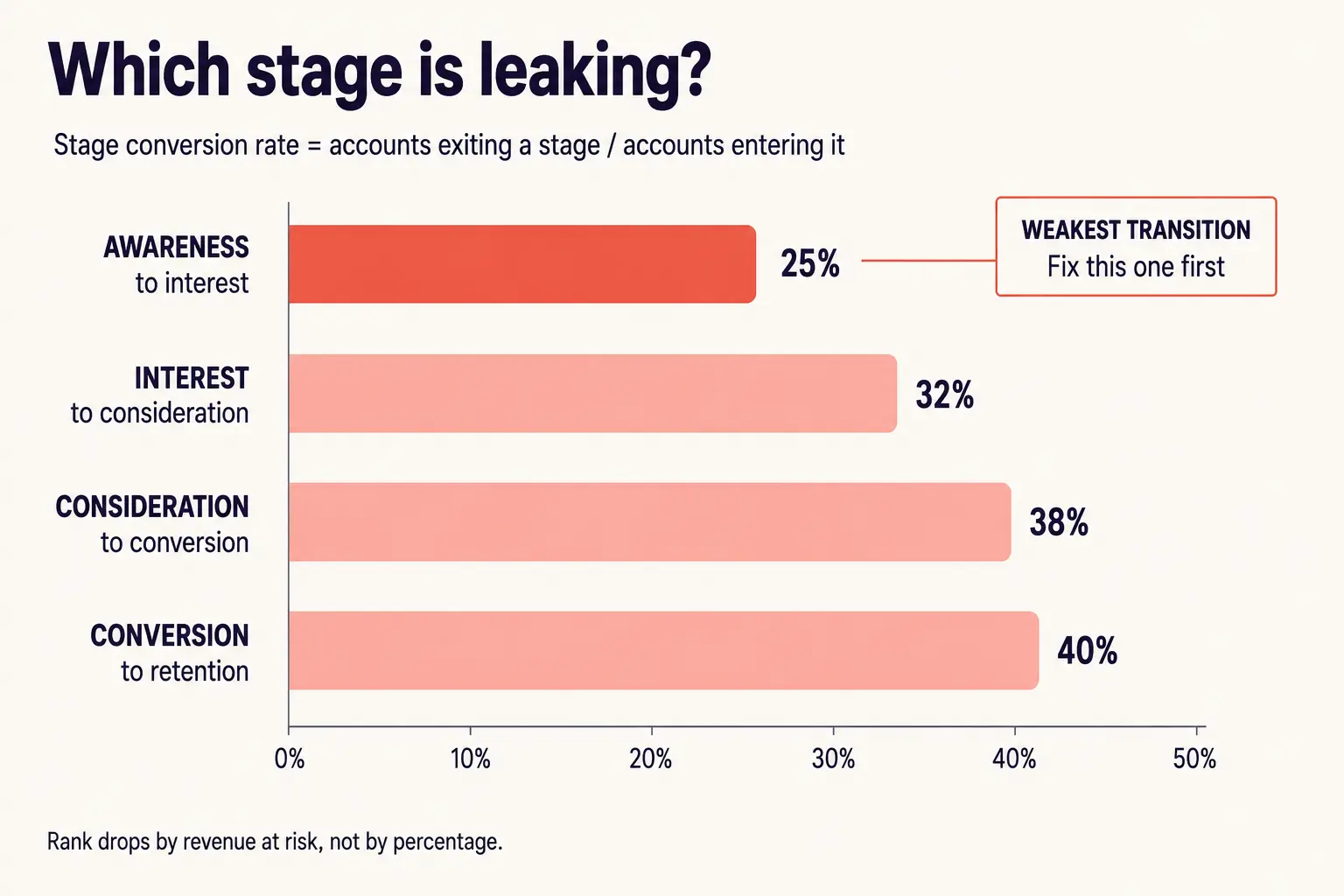
Then match the leak to a cause:
- Awareness to interest is weak. Your content targets category terms your buyers don't search yet, or your targeting is too wide.
- Interest to consideration is weak. You're invisible during research. Reviews, comparison content, and intent monitoring are the levers.
- Consideration to conversion is weak. Usually a coverage problem. Count contacts per deal before you rewrite a single email.
- Conversion to retention is weak. Onboarding, not sales. Check time-to-first-value before blaming the pipeline.
Two more checks before you touch messaging. Data quality sits underneath all of it, and B2B contact records decay fast as people change roles and companies. A funnel running on records nobody has verified in 18 months will underperform regardless of copy. Separately, improving conversion rates on landing pages helps only once the stage below them works. Feeding better traffic into a broken handoff wastes better leads.
Funnels also don't all look the same, which changes where you should expect the leak.
Customer Acquisition Funnel Examples
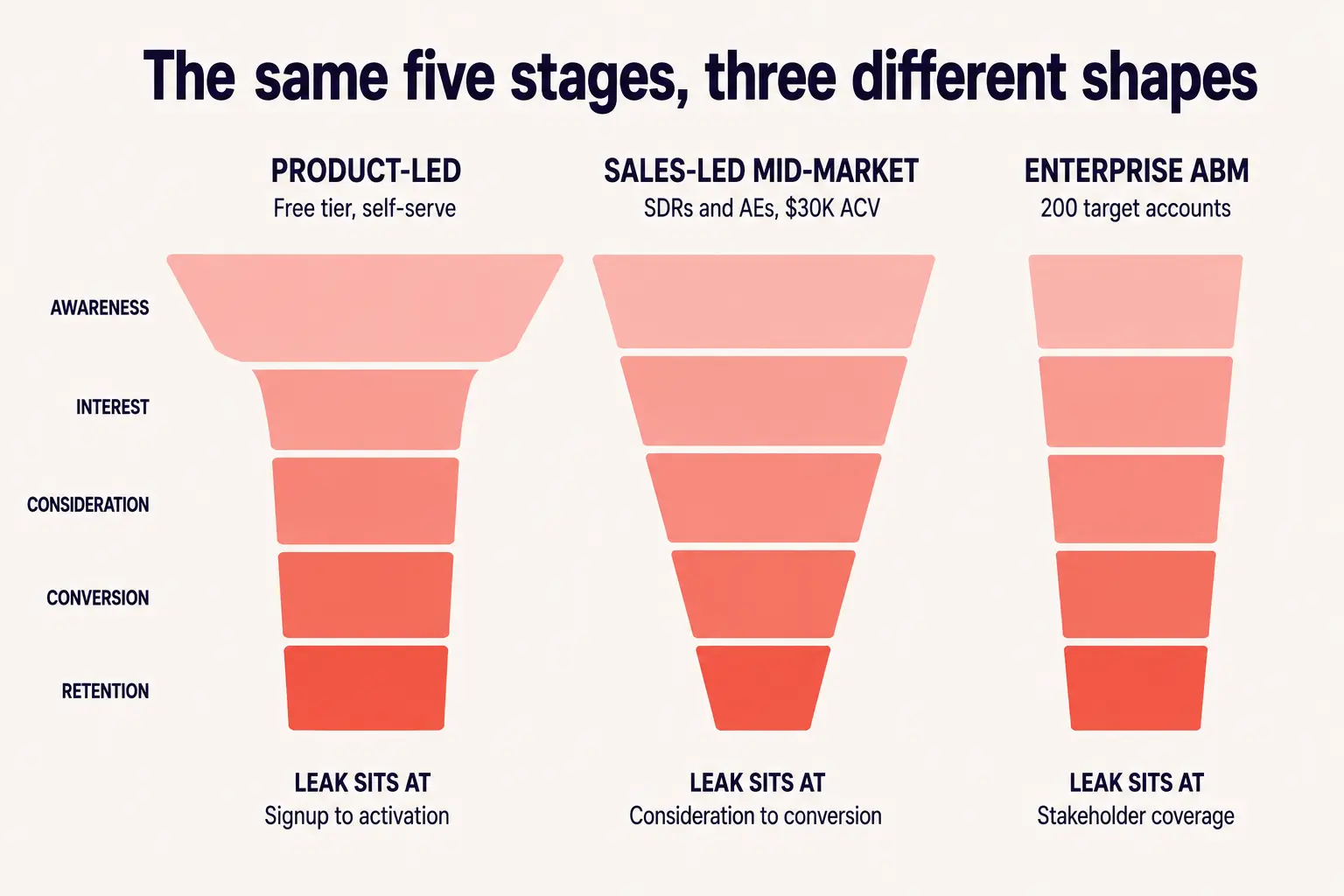
Three common shapes, and what breaks in each.
Self-serve, product-led. A developer tool with a free tier. Huge awareness stage, tiny CAC, payback under six months. The leak sits between signup and activation, so the whole funnel lives or dies on onboarding. Sales barely appears.
Sales-led mid-market. A $30K ACV platform sold through SDRs and AEs. Narrower top, CAC in the low thousands, payback around 12 to 18 months. The leak is usually at consideration to conversion, where a single-threaded deal meets a buying committee. Pipeline generation targets per rep matter more than total lead volume here.
Enterprise ABM. Six-figure deals, a target list of 200 accounts, cycles running past nine months. There's barely a top of funnel in the traditional sense. An account based marketing funnel measures account engagement depth rather than lead counts, because 200 accounts will never produce a statistically interesting conversion rate.
In my experience the shape of a funnel matters far more than what you call the stages. Notice that the same five apply to all three. What changes is where the volume sits and which transition breaks first.
Common Customer Acquisition Funnel Mistakes
Adding traffic on top of a broken middle. More visitors into a funnel that converts poorly at consideration produces a worse CAC, not a better quarter. Work upward from the weakest transition.
Single-threading every deal. One contact per account bets that one person will carry your deal past 20 colleagues. That bet loses often enough that I'd call it a structural flaw rather than a bad habit.
Measuring leads instead of accounts. Three people from one company are one opportunity, not three. Lead-level reporting inflates the top of your funnel and hides which accounts are really moving.
Letting definitions drift between teams. Real sales and marketing alignment lives in a shared definition of "qualified," not in a quarterly meeting. Without it, nobody can agree on where the leak is, so nobody fixes it.
Reporting CAC by channel without agreeing on attribution. Which channel gets credit depends entirely on the revenue attribution model you chose. Settle that before anyone argues about budget.
What the Diagram Leaves Out
Funnels don't lose deals. People do, at the seams between teams, on records nobody verified, in meetings nobody invited them to.
The best revenue teams I've come across aren't the ones with the cleanest funnel diagram. They're the ones who can tell you, without opening a dashboard, which transition is bleeding this quarter and what they're doing about it. They also treat winning a customer and keeping one as the same job. Their customer retention strategies go into the plan on day one, not six months later.
Find your worst transition. Fix that one. Then go find the next.
See how SMARTe finds verified mobile numbers and full buying groups inside your target accounts.