TL;DR:
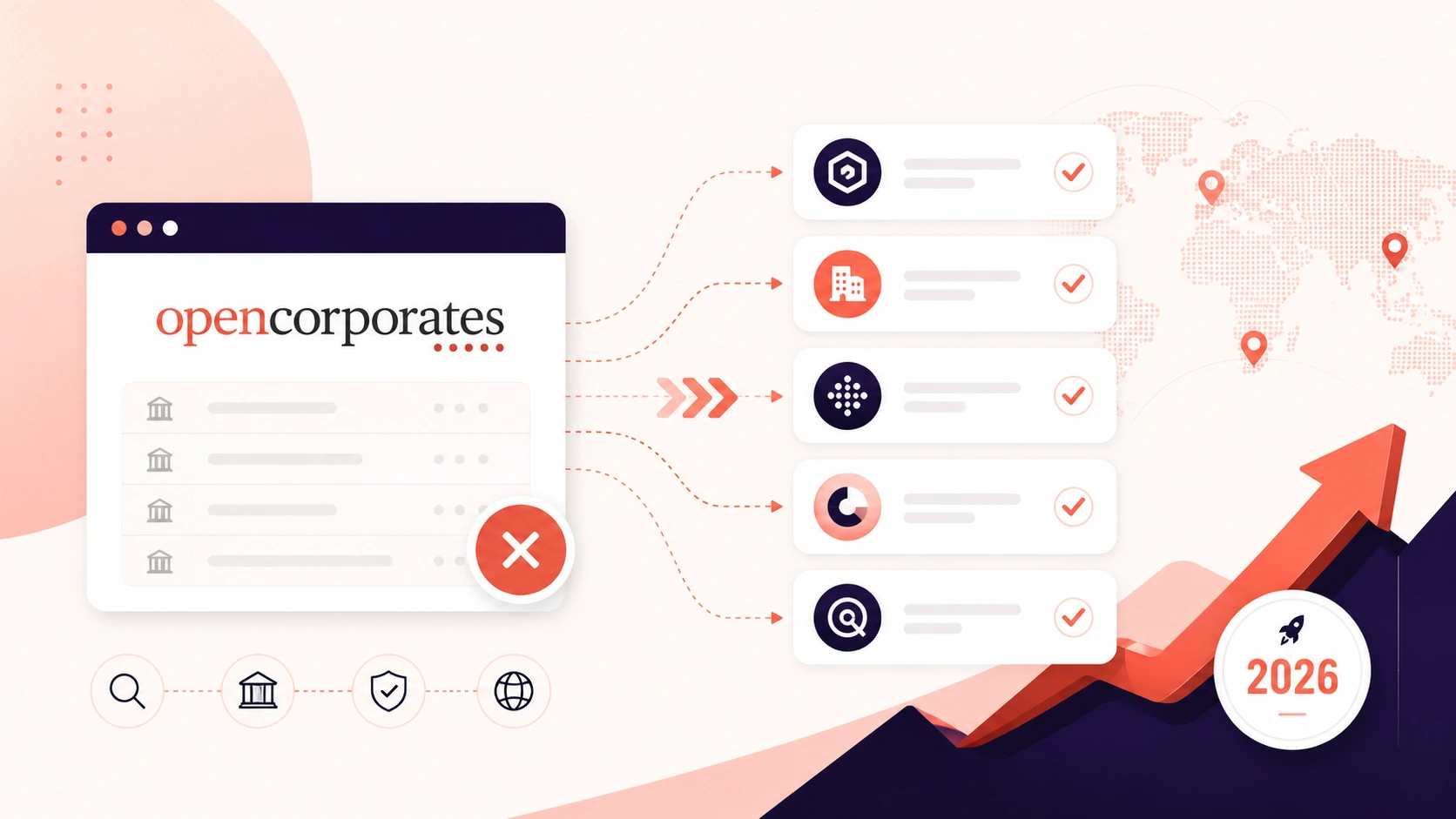
OpenCorporates is the largest open database of company registry records, used mostly by journalists, researchers, and compliance teams for basic entity checks. People look for alternatives once they hit its limits: the 500-calls-per-month API cap, roughly half of its registry sources no longer updating, no beneficial ownership data, and zero contact details for sales.
- The best alternative depends on the job. There is no single winner.
- For KYB and due diligence, look at Sayari, Moody's Orbis, and Creditsafe.
- For beneficial ownership and risk, Sayari and Moody's Orbis go deepest.
- For free company data, Companies House and SEC EDGAR cost nothing.
- For developers who need an API, Coresignal and Global Database scale far past 500 calls a month.
- For B2B sales and contact data, SMARTe, ZoomInfo, Apollo, and Cognism give you what a registry never will: verified emails and direct dials.
Most people look for an OpenCorporates alternative when they hit a limit. The entry API plan allows only 500 calls per month and 200 per day. If you need more, the next plan costs £6,600 a year. The data is limited too. You can see that a company exists, but you won't find much else. Details like beneficial owners, revenue, email addresses, and phone numbers are missing.
The bigger issue is that people use company data for different reasons. A compliance analyst tracking ownership needs one type of tool. A developer looking for a lower-cost API needs another. An SDR searching for a CFO's phone number needs something completely different.
Most comparison lists ignore this. They put every tool in the same bucket.
This guide doesn't. Instead of giving you a generic list, it matches tools to the job you need to do. Find your use case and skip the rest.
Why teams outgrow OpenCorporates
OpenCorporates did something useful. It pulled company records out of scattered government portals and made them searchable in one place. Journalists and NGOs still rely on it for exactly that.
But the gaps show up fast for professional use.
- The entry API plan caps at 500 calls a month, 200 a day. Higher tiers lift that, but the price climbs fast. Even searches that return nothing burn a credit.
- Around half the registry sources are stale. Some jurisdictions stopped updating years ago, and B2B data decay makes old records worse by the month.
- There's no enrichment. No revenue, no headcount, no tech stack, no website data.
- Beneficial ownership is thin and user-contributed, not authoritative.
- Financials come as PDFs, not structured data you can actually query.
- There's zero contact data. No emails, no direct dials, nothing for outreach.
None of that makes OpenCorporates bad. It makes it narrow. The fix isn't a "better OpenCorporates." It's the right tool for your specific job.
How to pick the right OpenCorporates alternative
Match the tool to the question you're trying to answer.
Are you verifying that a business is real and safe to onboard? That's KYB. Are you tracing who actually owns a shell company three layers deep? That's beneficial ownership. Do you just need free filings for research? That's a different shelf entirely. Pulling data into your own product at scale? You want an API. Trying to call a decision-maker tomorrow morning? You want contact data, and a registry will never give you that.
Five buckets, below. Jump to yours.
Best alternatives for KYB and due diligence
This is where most OpenCorporates refugees land. You need to verify entities, screen for risk, and document it well enough to satisfy an auditor.
Sayari

Best for: Compliance and investigation teams that need to see ownership networks and trade risk, not just a company name.
Sayari is what you reach for when "does this company exist?" isn't the real question. The real question is who owns it, who it trades with, and what's hiding two tiers down. It pulls corporate and trade data from more than 250 jurisdictions and maps the connections between entities.
The customer list tells you who it's built for. US Customs and Border Protection, the US Treasury, and HSBC all use it. This is government-grade risk intelligence, not a sales tool.
Top features
- Ownership network mapping across borders, with visual graphs of who connects to whom.
- Trade and shipping data to trace supply chains down to sub-tier suppliers.
- Sanctions and watchlist screening built in.
- Coverage spanning 500 million companies and billions of entity relationships.
Pros
- Unmatched for tracing hidden ownership and shell-company networks.
- Trade data adds context no pure registry tool has.
- Trusted by major government agencies and financial institutions.
Cons
- Enterprise-only pricing, and it isn't cheap.
- Built for investigation, not for sales or CRM enrichment.
- Coverage depth varies by jurisdiction.
Pricing: Custom enterprise pricing. Sayari doesn't publish rates publicly.
Why it beats OpenCorporates: OpenCorporates lists the company. Sayari shows you the web of ownership and risk behind it. For sanctions exposure or supply-chain due diligence, that depth is the whole point.
Moody's Orbis (Bureau van Dijk)

Best for: Banks, auditors, and M&A teams that need standardized financials and deep ownership trees.
Orbis, formerly Bureau van Dijk, is the heavyweight in private-company financial data. Moody's acquired Bureau van Dijk back in 2017, and Orbis remains the reference database for institutions that can't afford a mistake. It covers a vast set of global entities with normalized financials you can actually compare across countries.
I'll be honest about the trade-off here. Orbis is the most authoritative option on this list, and the most expensive by a wide margin. If you're a two-person startup doing light KYB, this is not your tool.
Top features
- Standardized financial statements going back years, comparable across jurisdictions.
- Detailed ultimate beneficial owner (UBO) hierarchies.
- Credit scores and risk indicators.
- M&A and deal intelligence.
Pros
- The gold standard for financial depth and ownership data.
- Normalized financials save analysts enormous cleanup time.
- Trusted across banking, audit, and legal.
Cons
- Very expensive, enterprise contracts only.
- Steep learning curve.
- Overkill for simple entity checks.
Pricing: Custom enterprise pricing, typically well into five figures per year.
Why it beats OpenCorporates: OpenCorporates gives you PDF filings. Orbis gives you structured, comparable financials and real UBO hierarchies. When a billion-dollar decision rides on the data, that gap matters.
Creditsafe

Best for: SMBs and finance teams that want fast credit checks without an enterprise contract.
Not every due-diligence job needs a Sayari-grade investigation. Sometimes you just need to know if a company pays its bills before you extend terms. Creditsafe handles that well, and it's far more accessible on price than the enterprise names above.
It carries a 4.4 out of 5 rating on G2 and covers roughly 500 million companies across more than 200 countries. The reports lean toward credit risk: scores, payment behavior, insolvency prediction.
Top features
- Business credit scores and risk ratings.
- Insolvency prediction with early-warning alerts.
- Payment behavior data on companies you're vetting.
- API access for pulling checks into your own systems.
Pros
- Affordable compared to Orbis or Dun and Bradstreet.
- Easy for non-technical finance teams, no training needed.
- Fast reports, often delivered instantly.
Cons
- Lighter on UBO and ownership mapping than compliance-first tools.
- Coverage is strongest in Europe.
- Credit scores may not satisfy every regulatory standard.
Pricing: Subscription plans for SMBs, with custom API pricing for higher volume.
Why it beats OpenCorporates: OpenCorporates can't tell you if a company is about to go under. Creditsafe can, with a score and an alert.
Best alternatives for beneficial ownership and risk
If your core job is uncovering ultimate beneficial owners, screening for politically exposed persons, or checking sanctions exposure, you need ownership-first tools. Two names matter most here, and you've already met them.
Sayari leads for cross-border ownership networks and trade risk. Its graph view connects entities across 250-plus jurisdictions, which is exactly what you want when ownership is deliberately obscured.
Moody's Orbis goes deepest on formal UBO hierarchies tied to financial data. Banks and auditors lean on it because the ownership trees run deep and the financials come pre-standardized.
A quick caveat worth stating plainly. OpenCorporates does surface officers and shareholders where registries publish them. So for simple, single-layer ownership in a well-maintained jurisdiction, it can still do the job for free. The moment ownership crosses borders or hides behind nominees, you need a purpose-built tool. That's the line.
What to do: If most of your UBO work is in one or two well-updated jurisdictions, test OpenCorporates first. If you're untangling cross-border structures or screening against sanctions lists, budget for Sayari or Orbis. The middle ground rarely works.
Best free and open-data alternatives
A big share of people searching for OpenCorporates alternatives want one thing above all: free. OpenCorporates built its name on open access, so "alternative" often means "another free option." Here's where to look.
Companies House
Best for: Anyone researching UK companies who wants official data at no cost.
Companies House is the UK's official corporate registry. It's free, it's authoritative, and it's the primary source OpenCorporates itself pulls from for UK records. You get incorporation details, officers, filing history, document images, and insolvency data.
Top features
- Free search and viewing of UK company records.
- Filing history with downloadable document images.
- Email alerts when a company files something new.
- Bulk data available as monthly CSV snapshots.
Pros
- Completely free, including a usable API.
- Authoritative first-party data.
- No call caps to speak of for normal use.
Cons
- UK only.
- No enrichment, no contact data, no UBO mapping beyond filed records.
Pricing: Free. Certified copies carry a small fee.
SEC EDGAR
Best for: Researching US public companies and their filings.
EDGAR is the SEC's free system for US public-company filings. If you need 10-Ks, annual reports, insider transactions, or ownership filings for listed companies, this is the source. It's been running full-text search since 2001 and offers a free API.
Top features
- Full-text search across decades of filings.
- Real-time feed of new submissions.
- Free programmatic access via the API.
- Detailed ownership filings for public companies.
Pros
- Free and authoritative for US public filings.
- Deep historical archive.
- No usage caps for standard access.
Cons
- US public companies only. Private firms aren't here.
- Filing-focused, so no contact or enrichment data.
Pricing: Free.
A reality check on the free route. Free almost always means limited. Companies House stops at the UK border. EDGAR only covers public filers. Neither gives you ownership intelligence or contact data. For research and basic verification, they're excellent. For anything commercial or cross-border, you'll outgrow them quickly.
Best alternatives for developers and API access
The 500-calls-a-month cap is the single most cited reason developers leave OpenCorporates. If you're building anything that queries company data at scale, that ceiling is a dealbreaker. (If you're weighing build options, this guide to choosing a company data API covers the trade-offs.) These options are built for volume.
Coresignal

Best for: Data teams and developers who need company and workforce data at scale through a clean API.
Coresignal scans public web data to build rich company and employee datasets. It's less about registry filings and more about the living signals around a company: hiring trends, headcount growth, digital footprint. Investment and HR research teams use it heavily because that data signals momentum before it shows up anywhere official.
Top features
- Deep records with dozens to hundreds of data points per company.
- Monthly data refreshes.
- Workforce and hiring-trend data.
- Developer-focused API and a no-code explorer.
Pros
- Excellent for employee and growth-trend analysis.
- Clean, analysis-ready data.
- Built for programmatic consumption.
Cons
- No free samples to test.
- Higher entry price than basic tools.
- Less focused on registry or compliance data.
Pricing: Custom, with plans built around data volume.
Why it beats OpenCorporates: It trades static filings for living signals, and the API actually scales for production use.
Global Database
Best for: Teams that want registry data, financials, and executive contacts through one API.
Global Database tries to bridge worlds. It connects directly to official registries while also layering on financials, credit data, and executive contacts. That makes it a genuine all-rounder for teams that need both compliance-grade records and commercial data from a single source.
Top features
- Direct registry connections across global coverage.
- Years of digitized financial statements.
- Executive contact details, including emails and phones.
- Credit scores and an API with strong throughput.
Pros
- Combines registry, financial, and contact data in one place.
- API rate limits dwarf OpenCorporates.
- Useful for both compliance and sales.
Cons
- Per-call pricing can climb at high volume.
- Heavier than you need for simple lookups.
- Coverage thins in some smaller regions.
Pricing: Per-call API pricing with custom enterprise plans.
Why it beats OpenCorporates: Far higher API throughput, plus financials and contacts a registry simply doesn't carry.
Best alternatives for B2B sales and prospecting
Here's the honest truth for sales teams. OpenCorporates was never built for you. It confirms a company is real. It will never hand you the email or mobile number of the VP you want to reach. (If reaching people by phone is the whole game, here's how to find someone's phone number the right way.) For that, you need a sales intelligence platform, and the gap between the two is enormous.
This is the bucket where SMARTe belongs, so I'll start there and tell you plainly where it wins and where it doesn't. If you want a wider view first, here's a breakdown of the best sales intelligence tools across the category.
SMARTe

Best for: Global GTM teams that need verified emails, direct dials, and real-time enrichment for outbound.
SMARTe is a B2B sales intelligence platform built for go-to-market teams. Where a registry stops at the company name, SMARTe gives you the verified contact data to actually reach people inside that company. It runs on a database of 289M+ verified B2B contacts and 66M+ company profiles, with coverage across 200-plus countries.
The thing that sets it apart for me is the mobile coverage. SMARTe has 75%+ US mobile and direct dial coverage and 50%+ global direct dial coverage, which is where a lot of US-first tools fall apart the moment you sell outside North America. Data gets verified in real time rather than pulled from a stale batch, so what you reach for is fresh at the point of use. It also handles lead enrichment and fills gaps in your existing records automatically.
Top features
- 289M+ verified B2B contacts with emails and direct dials.
- 75%+ US mobile coverage, 50%+ global, with real-time verification.
- Advanced filters: revenue, company size, industry, technographics.
- Native Salesforce and Outreach integrations, plus a browser extension for LinkedIn.
- Bombora intent data built in, and job-change tracking on your key contacts.
- 90%+ CRM match rate for enrichment at scale.
Pros
- Strong global mobile coverage, not just North America.
- Real-time verified data that stays fresh.
- Real free tier to test with, no credit card.
Cons
- Built for B2B sales teams, not personal lookups or compliance.
- No UBO or beneficial ownership data. That's not what it does.
- Enterprise depth means it's more than a solo prospector needs.
Pricing: Free plan with 10 credits, no credit card. Pro from $25/month with shared, pay-per-credit pricing. Enterprise from $15,000/year with per-credit rates dropping at volume.
Why it beats OpenCorporates: Different universe. OpenCorporates verifies a legal entity. SMARTe hands you the verified mobile number of the person you need to call, anywhere in the world, which is what real sales prospecting runs on.
ZoomInfo
Best for: US enterprise sales teams that want the deepest North American contact database.
ZoomInfo is the most recognized name in the category, and for good reason. It pairs a huge contact database with intent data and org charts, and it's the default for many large US sales orgs. It holds 250+ million professional profiles and over 100 million company profiles, with direct dials and verified emails. On G2 it carries a 4.5 out of 5 rating across 12,600-plus reviews.
It's the strongest tool here for North American depth. The catch is price and international reach, both of which trip teams up.
Top features
- Massive contact database with direct dials and verified emails.
- Intent data showing which accounts are researching your category.
- Org charts and decision-maker mapping.
- Deep CRM and marketing integrations.
Pros
- Hard to beat for US contact volume and accuracy.
- Mature intent data and firmographics.
- Plugs into nearly every sales and marketing stack.
Cons
- Expensive, with entry pricing around $14,995 a year.
- International coverage is weaker than its North American data.
- Long annual contracts, and some users report data accuracy gaps.
Pricing: Custom, with entry points reported around $14,995+ per year.
Why it beats OpenCorporates: It turns a company name into a named decision-maker with a phone number and a buying signal.
Apollo.io
Best for: Startups and growth teams that want scale and an all-in-one toolkit on a budget.
Apollo is the volume-and-value pick. It bundles a large database with built-in email and calling tools, so smaller teams can search, enrich, and reach out from one tab. It holds over 210 million contacts and carries a strong 4.7 out of 5 on G2 across 9,400-plus reviews.
The pricing is the draw. A usable free plan, then paid tiers that stay affordable, at least on paper.
Top features
- 210M+ contacts with built-in email and dialer tools.
- Sequences and engagement features in the platform.
- Buying intent data on paid plans.
- Generous free tier for testing.
Pros
- Excellent value for scaling teams.
- All-in-one, so less tool sprawl.
- The free plan actually works for testing.
Cons
- Credit costs add up fast once you need mobile numbers at volume.
- Data accuracy varies, with reported email bounce on some segments.
- Mobile data is weaker for mid-market and enterprise contacts.
Pricing: Free plan available. Basic from $49/user/month (annual), Professional $79, Organization $119. Monthly billing runs higher.
Why it beats OpenCorporates: Scale plus execution. You go from a list to a sent sequence without leaving the tool.
Cognism
Best for: Teams selling into Europe that need GDPR-compliant, phone-verified mobile numbers.
If your outbound runs through the UK and EMEA, Cognism earns its spot. Its flagship Diamond Data comes from manually phone-verified mobile numbers. That's why European teams report connect rates well above what US-first databases deliver in the same regions. It holds 440M+ contacts and carries a 4.6 out of 5 on G2 across roughly 1,200 reviews, with GDPR compliance treated as a core feature rather than a bolt-on.
Top features
- Diamond Data, phone-verified mobile numbers.
- GDPR-first compliance with do-not-call screening across markets.
- Bombora-powered intent data.
- Chrome extension for prospecting from LinkedIn.
Pros
- Best-in-class European mobile accuracy.
- Compliance built in for regulated markets.
- High connect rates for UK and DACH outbound.
Cons
- Premium pricing, typically starting around $15,000 a year.
- North American coverage is thinner than its EU data.
- Annual contracts only, no free plan.
Pricing: Custom, annual only. User reports put team plans roughly in the $15,000 to $50,000 per year range.
Why it beats OpenCorporates: It gives you compliant, verified ways to actually phone the people behind the company, which a registry never could.
Quick comparison: which alternative fits your use case
Conclusion
"What's the best OpenCorporates alternative?" is the wrong question. The right one is "what does my data actually need to do?" A compliance analyst and an SDR are looking at the same search result and seeing two completely different problems.
Sort by the job, and the choice gets obvious. Need to trace hidden ownership? Sayari or Orbis. Need free UK filings? Companies House. Need to call a CFO in São Paulo next week? You need verified contact data, and a registry will never give you that.
That's the real line running through this whole list. Registry tools tell you a company exists. Sales intelligence tools tell you who to reach and how. If your work depends on the second, try SMARTe free and see how global verified data changes your connect rate. No credit card required.