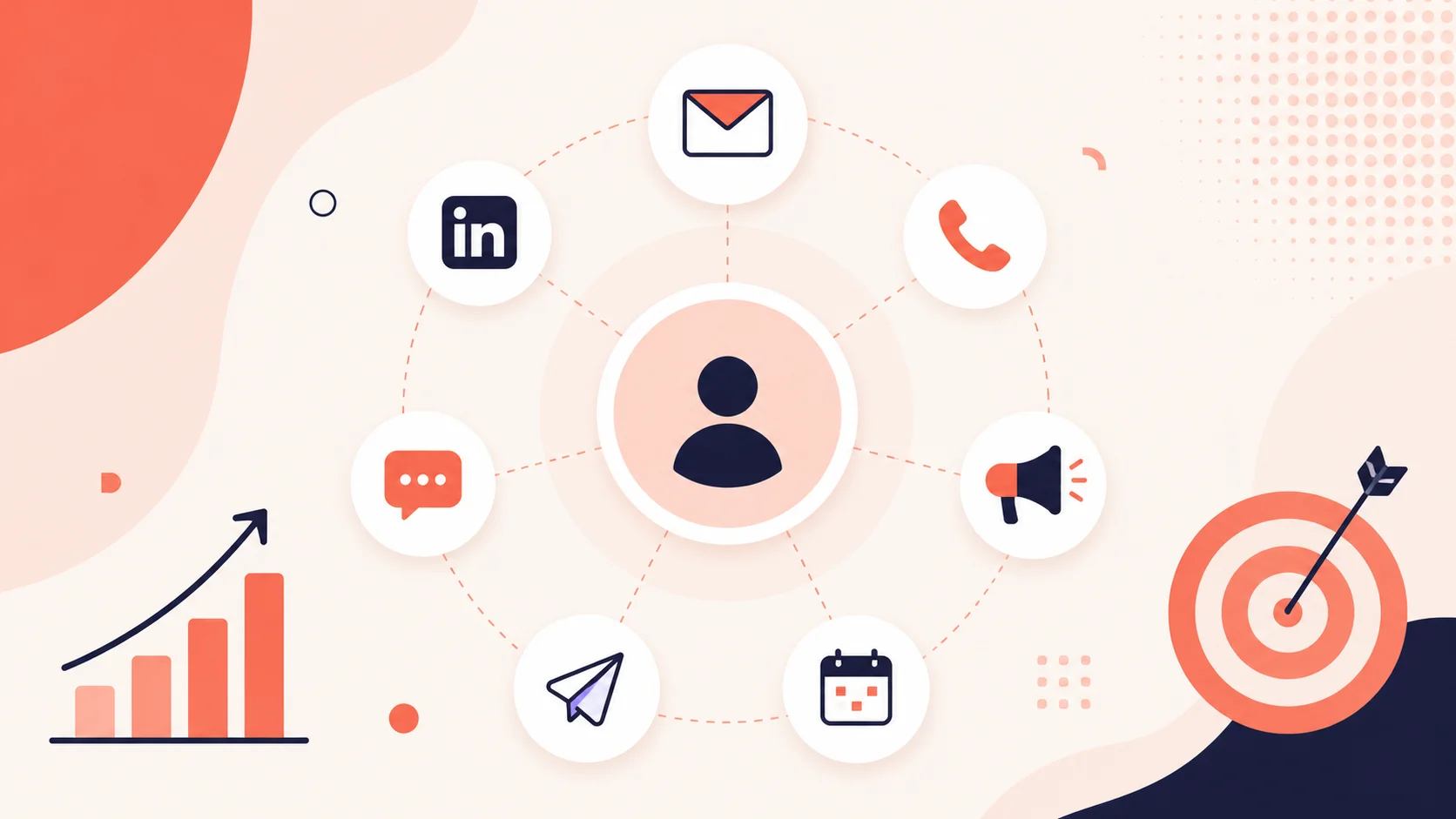
Multi channel prospecting means reaching the same prospect across email, phone, LinkedIn, and sometimes video or SMS, inside one coordinated sequence with a single story running through it.
The word doing the work there is coordinated. Sending an email, then a connection request, then a cold call, with no thread tying them together, is not multi channel prospecting. That's three single-channel campaigns aimed at one tired person.
Gartner's research puts the share of a B2B buying journey spent meeting potential suppliers at around 17%. The other 83% happens without you in the room. Multi channel exists to win a slightly larger slice of that 17%, and to be visible during the rest of it.
So below: what each channel is genuinely good at, how to build a sequence that holds together, which numbers to trust, and the failure modes that kill most of these programs by month three.
What Is Multi Channel Prospecting?
It's a prospecting motion where one rep works one prospect across two or more channels, with messaging that carries over between them.
A real example of the carry-over: your call references the case study you emailed. Your LinkedIn message references the voicemail. Each touch assumes the previous one happened, even though most of them didn't land.
That assumption is the point. The prospect who ignored four emails and then answers a call has, from their side, met you once. Your job is to make that one interaction feel like the middle of a conversation rather than the start of a pitch.
Multi Channel vs Omnichannel vs Single Channel
These get used interchangeably, which muddies planning conversations.
Single channel means one channel, usually email, run at volume. Cheap, fast, and increasingly ignored.
Multi channel means two or more channels running in a planned sequence. The rep decides the order and the spacing.
Omnichannel means the prospect's behavior decides what happens next. They open the pricing page, so the next touch is a call rather than the scheduled email. Most teams claim omnichannel and run multi channel. There's nothing wrong with that, but the distinction matters when you're buying tooling to support it.
Still mapping the basics? B2B prospecting covers the foundations. Prospecting vs lead generation sorts out a distinction that trips up new SDR teams.
Why Single Channel Outbound Stopped Working
Three things happened roughly at once.
Buyers Pulled Away From Sellers
Gartner's work on the modern buying journey found that about 75% of B2B buyers would prefer a rep-free experience. Roughly 80% of the journey now happens without direct vendor contact.
Read that as a channel problem, not a relationship problem. Buyers didn't stop wanting information. They stopped wanting to get it through a scheduled call with someone who hasn't read their website.
Email Got Crowded and Deliverability Got Strict
Cold email reply rates on unsegmented lists sit near 1% to 2% by most vendor reporting. Strong performers land closer to 5% to 8%. Both numbers have drifted down for years, as inbox providers tightened filtering and everyone with a laptop started sending.
You can still win on email. You just can't win on email alone, and you certainly can't win on email volume. Worth reading alongside this: cold email for the fundamentals and email warm up tools if your domains are new.
Buying Groups Got Bigger
Complex B2B purchases involve roughly six to ten decision-makers by Gartner's count. Forrester puts the average enterprise buying group nearer thirteen.
One channel reaches one kind of person. Your technical evaluator lives on email. Your economic buyer never opens one but answers a mobile. Your champion is active on LinkedIn every day. A single-channel sequence selects for one personality type and quietly ignores the rest of the committee.
What Each Channel Is Actually Good At
Stop thinking of channels as interchangeable touchpoints. They do different jobs.
Good at: volume, detail, attachments, anything the prospect needs to forward internally.
Bad at: urgency, nuance, standing out.
Email is your workhorse and your paper trail. It's also the channel where personalization pays the steepest dividends, because the baseline is so low. Our guide to cold email personalization covers what actually moves reply rates, and cold email subject lines handles the part that decides whether the rest gets read.
Budget 200 to 400 sends per inbox per day as a safe ceiling. Push past it and deliverability starts eroding in ways you won't notice until a month later.
Phone
Good at: real conversations, objection handling, qualifying in minutes rather than weeks.
Bad at: scale, and reaching anyone whose number you don't actually have.
Dial-to-conversation rates hover near 5% to 9% in most published benchmarks, with dials-to-meetings around 3% to 4%. Those sound grim until you compare the quality of a conversation to the quality of an email reply. Which is roughly the argument in is cold calling dead, and the answer there is no, just harder.
The variable nobody controls for is number accuracy. A rep dialing switchboards gets a different result than a rep dialing verified direct dials, and that gap dwarfs anything a script change delivers. Phone prospecting covers technique, and the best time of day for B2B cold calling covers timing. If gatekeepers are your bottleneck, getting past the gatekeeper is the practical fix, though a direct mobile skips the problem entirely.
Good at: warming someone before you interrupt them, reaching people who ignore email, and being visible during the 80% where you're not in the room.
Bad at: volume. This is a hard constraint, not a tuning problem.
Connection requests cap out around 15 to 20 a day before LinkedIn starts restricting accounts. InMail runs on monthly credits tied to your plan, and LinkedIn documents how those InMail credits and renewals work. Plan your sequence around those ceilings or you'll build a cadence your team physically cannot run.
Acceptance rates on personalized connection requests land somewhere near 45% in vendor reporting, against the teens for generic templates. Treat that spread as directional rather than precise, but the direction is consistent everywhere.
LinkedIn prospecting covers the motion, LinkedIn limits covers the constraints in detail, and LinkedIn messaging templates gives you starting points worth rewriting.
Video and Voice Notes
Good at: cutting through at the exact moment a sequence usually dies, around touch five or six.
Bad at: everything else. They take real time, and they don't scale.
I'd use these on maybe 10% of your accounts, chosen deliberately. A personalized video to every name on a 500-account list is how an SDR burns a week and books nothing.
SMS and WhatsApp
Good at: confirmations, reschedules, and late-stage nudges with someone who already knows you.
Bad at: cold opens, and legally risky in a lot of markets.
Honestly, I'd keep these out of cold sequences altogether. The compliance exposure isn't worth the marginal lift, and the one thing worse than being ignored is being reported.
Be Skeptical of Multi Channel Statistics
This section exists because I went looking for the numbers and found something uncomfortable.
Nearly every dramatic multi-channel lift figure traces back to one of three places. An ecommerce study about email and SMS campaigns, which has nothing to do with B2B prospecting. A vendor's own customer data, with no methodology attached. Or another blog post citing one of the first two.
The "287% more orders" stat you've seen in a dozen LinkedIn posts is from retail marketing automation. It's a real study. It's just not about your SDR team.
Treat claims like "3x reply rates" and "35% engagement lift" as marketing until someone shows you the sample size and the control group. Most won't.
What I'd actually trust: your own numbers, measured against your own single-channel baseline, over at least one full sales cycle. Run multi channel on half your territory and email-only on the other half for a quarter. That comparison is worth more than every benchmark post on the internet, including this one.
With that caveat in mind, B2B prospecting statistics collects what's out there.
How to Build a Multi Channel Prospecting Sequence
Six steps. The order matters more than the specifics.
Step 1: Fix the List Before You Fix the Sequence
A multi channel sequence needs three things per contact: a verified email, a verified mobile, and a LinkedIn profile. Miss one and the sequence quietly collapses into single channel for that prospect.
Run the audit first. What percentage of your list has all three? If it's under 60%, your sequence design is not your problem. Our guide to building a prospecting list covers the standard, and cold call list covers what a dialable list specifically requires.
Step 2: Map the Buying Group, Not Just the Lead
Pick three to five contacts per account across different functions. Economic buyer, technical evaluator, end user, maybe a champion you've identified from a job change or a conference list.
Then vary the channel by role. Senior people answer mobiles and ignore email. Practitioners do the reverse. Running the identical sequence against a CFO and a DevOps lead wastes both, which is the trap outbound prospecting teams fall into when they scale a template that worked once.
Step 3: Choose a Length You Can Sustain
Most working B2B cadences run 12 to 18 touches over three to four weeks. There's no magic number, and anyone who tells you there is hasn't tested it on a different ICP.
What matters more than the count is whether your reps can actually execute it. A 22-touch cadence that gets run properly on 40 accounts beats a 30-touch cadence abandoned on 200. How to build a sales cadence goes deeper on structure.
Step 4: Sequence the Channels Deliberately
A structure that holds up across most B2B segments:
- Days 1 to 3. LinkedIn view and connection request. No pitch. You're establishing that you exist.
- Days 2 to 5. First email. Short, specific to their situation, one question.
- Days 4 to 7. First call, with a voicemail that references the email by name.
- Days 6 to 10. LinkedIn message if connected, or a second email with a different angle.
- Days 10 to 14. Second and third calls at different times of day.
- Days 14 to 21. Video or voice note on your top-tier accounts only.
- Days 21 to 28. Breakup email, then a 90-day hold.
Vary call timing across the week. A prospect who never answers at 9am on Tuesday may answer at 4pm on Thursday, and most teams never test for it. Have cold calling scripts ready for both, since the 4pm conversation rarely sounds like the 9am one.
Step 5: Write One Story, Not Six Messages
This is where most sequences fall apart, and it's rarely the part teams audit.
Each touch should advance a single argument about why this prospect, at this company, right now. If your email says one thing and your LinkedIn message says something unrelated, the prospect who sees both learns that you're running a template.
What to do: Read your whole sequence aloud in order, as if one person received every touch. If it doesn't sound like one human with one consistent point, rewrite it before launch.
Step 6: Define What Stops the Sequence
Decide three things in advance. What counts as a response worth pulling someone out for. Who handles it. And what happens to accounts that finish the sequence without replying.
A sequence with no exit logic turns into a machine for annoying people who already said no. Sales follow up email templates covers the reply paths, and SDR to AE handoff covers what happens when it works.
Metrics That Tell You Whether It's Working
Channel-level metrics will mislead you here, which is the central measurement problem with multi channel.
Your email reply rate might drop after you add calls. That looks like failure. But if meetings booked went up, the calls are converting people the emails warmed, and the email is doing its job invisibly.
So measure at the sequence level first:
- Meetings booked per 100 accounts worked. The number that actually matters.
- Accounts reached on two or more channels. Your coverage check. If it's low, step 1 of the build failed.
- Touches to first response. Tells you whether your sequence is too short, which it usually is.
- Sequence completion rate. If reps finish under 70% of sequences, your cadence is too long for the workload.
- Channel of first response. Run this quarterly. It tells you where to shift effort next quarter.
- Cost per meeting by channel mix. The one your VP will ask about.
Track channel-level reply rates underneath those, as diagnostics rather than scorecards. SDR metrics covers the wider set worth instrumenting.
Where Multi Channel Prospecting Goes Wrong
The same five failures, across very different teams.
The list can't support the sequence. You designed a seven-step cadence with three calls, and 40% of your contacts have no phone number. The sequence degrades to email-only without anyone noticing, and then someone concludes multi channel doesn't work.
Channels run in separate tools with no shared view. Email in one platform, dialer in another, LinkedIn in a browser tab. The rep has no single picture of what this prospect has received, so touches land out of order or twice. The right Chrome extensions for SDRs close some of that gap, though not all of it.
Reps get measured on activity, not sequence completion. Dial counts go up. Nobody finishes a cadence. Multi channel becomes a reporting label on top of the same single-channel behavior.
Personalization gets dropped to hit volume. Multi channel multiplies the writing load. If a rep is producing 18 touches per prospect, something gives, and it's usually the research. At that point you've built a more expensive way to send templates. Automated prospecting helps here, within limits worth understanding before you lean on it.
Nobody suppresses across channels. The prospect who replied "not now" to an email still gets called twice and messaged on LinkedIn. One broken suppression rule undoes a quarter of careful work.
The Data Layer Behind Every Multi Channel Sequence
Full disclosure: I work at SMARTe. Weigh this with that in mind, then go audit your own list before taking my word for any of it.
Multi channel prospecting has a prerequisite almost nobody budgets for. You can't call a number you don't have. You can't email an address that bounces. And you can't run a three-channel sequence against a record with one field filled in.
Which means list completeness is the ceiling on your entire program, and sequence design sits well below that ceiling.
SMARTe runs 289M+ verified B2B contacts and 66M+ company profiles across 200+ countries, with 75%+ US mobile coverage and 50%+ global direct dial coverage. The mobile figure is the one that matters for multi channel specifically, because the phone leg of your sequence lives or dies on it.
Verification runs in real time at the point of use, not on a quarterly batch. The number your rep dials was checked recently rather than last spring. Between a quarter and a third of contact data breaks every year, and a sequence built on stale records fails in ways that look like a messaging problem.
For the buying group work in step 2, AI agents surface the stakeholders per account instead of leaving a rep to guess. Enrichment runs at 90%+ match rates, so accounts already in your CRM get their missing phone and LinkedIn fields filled rather than sitting half-done. CRM data enrichment covers how that runs on a schedule.
Buying signals feed the same system. Funding rounds, leadership changes, headcount growth, and Bombora intent surface the accounts worth sequencing now. That timing is the difference between a cold sequence and a welcome one.
A browser extension pulls verified emails and mobiles straight from LinkedIn while a rep is already there. An MCP server lets ChatGPT or Claude query verified data live. Claude prospecting covers what that looks like in practice.
Enterprise plans start at $15,000 a year, credit-based, with no per-seat fees. For a team running multi channel across a full SDR bench, the absence of a seat tax changes the math more than the headline number does.
See how SMARTe finds verified mobile numbers in your target accounts.
Final Thoughts on Multi Channel Prospecting
Adding channels is the easy part. Any team can bolt a dialer onto an email tool in an afternoon and call it a multi channel program.
The hard part is making four touches feel like one conversation. Then sustaining that across a 15-step cadence, with data underneath it good enough to last until the sequence finishes.
Most teams that fail at this never had a sequencing problem. They had a list problem wearing a sequencing costume, and they spent two quarters rewriting email copy to fix it.
Check your coverage first. Then worry about the subject line.