TL;DR:
Firmographic data describes companies rather than people: industry, headcount, revenue band, headquarters, site count, ownership, and growth stage. These are the ten providers I'd shortlist.
- SMARTe leads on global firmographic depth, with 66M+ company profiles across 200+ countries and real-time verification instead of batch refresh.
- ZoomInfo owns North American company depth. Contracts start near $15,000 a year and pricing stays quote-only.
- Cognism fits EMEA-first teams. Apollo fits self-serve teams that want company data and outreach in one seat.
- Dun & Bradstreet still wins on corporate hierarchy and credit risk. Coresignal and People Data Labs sell raw records for teams building their own pipelines.
- Refresh cadence beats record count. Headcount and revenue bands drift within months of a funding round, an acquisition, or a layoff.
Firmographic data providers sell the company layer of your target list. Industry, headcount, revenue band, location, ownership, growth stage. Get that layer right and your ICP filter returns accounts worth calling.
Get it wrong and the failure is silent. Nothing bounces. No error appears in the CRM. Your segment just fills up with companies that outgrew you two funding rounds ago. The symptom shows up in a pipeline number three months later.
I compared ten providers below. Record counts look close on paper across every vendor. Refresh cadence and coverage outside North America are where they split, and those two decide whether a segment still works six months from now.
One note on budget. Four of these start free or under $100 a month. SMARTe, ZoomInfo, Cognism and Demandbase all start in five figures a year. Read the price column before the feature list.
How I compared these firmographic data providers
Six criteria. I weighted the last three heavier than vendors would like.
- Attribute depth: how many fields sit on a company record, and how many hold a real value on an average account rather than a flagship logo.
- Company coverage: total company profiles, and whether the number survives outside the US.
- Refresh cadence: continuous, monthly, quarterly, or whenever someone remembers. Quiet decay starts here.
- Delivery model: a UI you search, an API you call, or a bulk file you load into a warehouse. Getting this wrong costs an engineering quarter.
- Contract shape: self-serve, annual commit, platform fee plus seats, or metered credits.
- Published pricing: I read this as a proxy for how a vendor behaves at renewal. Teams that hide the rate card usually have a reason.
Coverage numbers are the easiest thing to inflate and the hardest to check. So refresh cadence carries more weight in my scoring than raw volume. A stale record still counts as a record. It just doesn't help anyone hit quota. A sharper ideal customer profile does more for a segment than switching vendors. Fix that first.
Firmographic data providers compared side by side
| Provider | Company coverage | Geographic strength | Delivery | Entry price | Best for |
|---|---|---|---|---|---|
| SMARTe | 66M+ profiles | Global, 200+ countries | UI, API, MCP, extension | From $15K/yr, enterprise only | Global firmographics with verified contacts |
| ZoomInfo | 100M+ | North America | UI, API | ~$14,995/yr reported | US enterprise depth |
| Cognism | Not disclosed | UK and EU | UI, API, DaaS | $15,000+/yr reported | EMEA-first outbound |
| Apollo.io | 30M+ | North America | UI, API, CLI, MCP | Free, $49/user/mo | Self-serve data plus outreach |
| Dun & Bradstreet | 500M+ records | Global entities | UI, API, files | $49/mo Essentials | Hierarchy and credit risk |
| Breeze Intelligence | 50M+ | Global, tech-weighted | HubSpot only | ~$45/mo plus HubSpot | HubSpot-native enrichment |
| Coresignal | 75M+ | Global, 50+ countries | API, bulk datasets | $49/mo | Warehouse and pipeline builds |
| People Data Labs | 30M+ | Global | API only | Free, $98/mo | Developers building products |
| Crunchbase | 4M+ private | US and Europe tech | UI, API | Free, $49/mo | Funding-stage targeting |
| Demandbase | 100M+ | North America and EU | Platform | ~$18,000/yr reported | Firmographics inside ABM |
The 10 best firmographic data providers
1. SMARTe

SMARTe is a global go-to-market data platform built for teams selling outside North America as much as inside it. It carries 289M+ verified B2B contacts and 66M+ company profiles across 200+ countries. Firmographics, technographics, and intent sit on the same record. Verification runs in real time rather than in a nightly batch.
Key features
- 66M+ company profiles with firmographic attributes across 200+ countries
- 289M+ verified B2B contacts tied to those company records
- Real-time data verification at the point of use, not batch processing
- 64K+ technographic products tracked alongside firmographic fields
- Bombora intent signals built in natively
- 90%+ CRM match rates for enrichment at scale
- Automated job change tracking on contact records
- Native Salesforce and Outreach apps, plus API and MCP access for LLMs
- SMARTe Prospector browser extension for LinkedIn and company sites
- SOC 2 Type II certification, GDPR alignment, CCPA compliance
What I like about SMARTe
- Coverage survives outside the US. 50%+ global B2B direct dial coverage, with real depth across LATAM and APAC where other vendors run shallow.
- Firmographics sit next to verified contacts, so a segment turns into a callable list without a second vendor and a second contract.
- 75%+ US mobile coverage means the account you qualified firmographically stays reachable.
- Real-time B2B data verification means the headcount band you filtered on reflects today, not last quarter's snapshot.
- The starting price is public. No demo gate before you see a number, which is more than ZoomInfo, Cognism or Demandbase offer.
- No per-seat cost, so a team shares one credit pool.
What could be better
- Enterprise only, from $15,000 a year, with no free or self-serve tier. A two-person startup should look at Apollo or People Data Labs instead, and you can't test coverage yourself before a conversation.
- Brand recognition trails ZoomInfo. Procurement teams sometimes ask more questions than they would for the incumbent.
- Teams that only want raw bulk firmographic files for a warehouse will find the platform does more than they need.
Pricing
Enterprise only, from $15,000 a year, with credits starting at $0.30 and falling to $0.20 at 1M credits. No per-seat charge, so the whole team shares one credit pool. There is no free or self-serve plan. Evaluation runs through a sample match against your own accounts.
Final verdict
Pick SMARTe when your territory map runs past North America and the budget is funded. Also pick it when the company record and the contact record need to come from one source. The real-time verification model is the part I'd pay for. Batch refresh is why segments rot, and SMARTe doesn't run one.
2. ZoomInfo
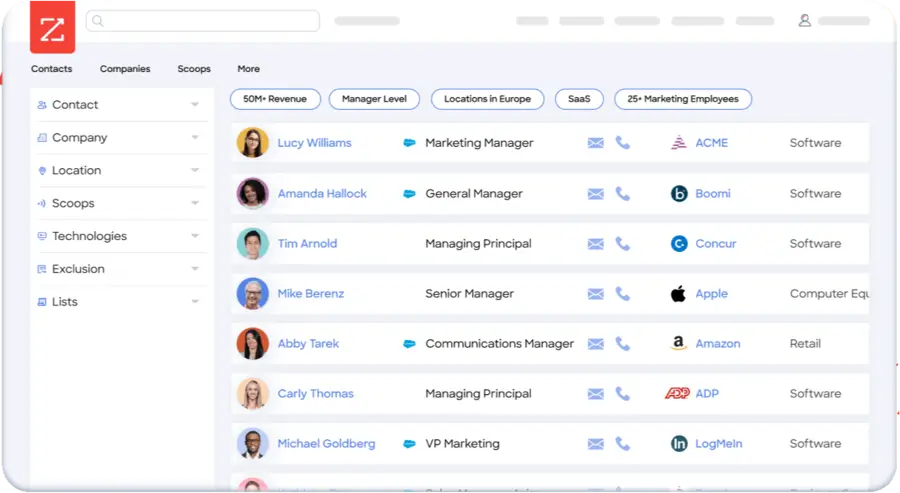
Ask a US enterprise RevOps lead which vendor they run and you'll hear ZoomInfo. Roughly 100M+ company profiles, with contact, intent, and org chart layers stacked on top. The data earns the reputation. The commercial experience is where buyers complain.
Key features
- 100M+ company profiles with deep firmographic and technographic attributes
- Org charts and corporate hierarchy mapping
- Buyer intent signals on the Advanced tier and above
- Website visitor identification
- Chorus conversation intelligence in higher bundles
- Copilot AI features for account prioritisation
- Broad CRM and sales engagement integrations
- Chrome extension for LinkedIn prospecting
Where ZoomInfo earns its price
- North American company and contact depth stays the benchmark. Nobody has matched it at scale.
- Org chart and hierarchy data help you sell into large accounts with real buying committees.
- Intent, firmographics, and technographics live in one platform, so RevOps maintains one integration instead of four.
- Salesforce, HubSpot, Outreach, Salesloft, Marketo. The integration list rarely blocks a stack decision.
What could be better
- Pricing stays hidden. Every number comes from a sales call, and ZoomInfo pricing climbs fast once seats and add-ons stack.
- Coverage drops off outside North America, and the International Data Passport add-on carries its own line item.
- Annual contracts auto-renew. Miss the window and you've signed for another year at the old rate.
- Credit overages and intent add-ons push real spend well past the entry quote.
Pricing
ZoomInfo publishes nothing. Buyer-reported figures put Professional near $14,995 a year, Advanced around $25,000, and Elite at $39,995 and up. Vendr's verified purchase data puts the median contract close to $31,875 a year. All plans run annual with a three-seat minimum.
Final verdict
If your entire motion is US enterprise and budget isn't the constraint, ZoomInfo is a defensible choice. For everyone else the math gets uncomfortable fast, and the ZoomInfo alternatives shortlist tends to appear a few weeks before renewal.
3. Cognism

Cognism built its reputation on EMEA. Phone-verified mobile numbers, a clean GDPR posture, and firmographic coverage that holds across the UK and EU where American vendors get patchy. Two prospecting tiers, with Bombora intent layered into the higher one.
Key features
- Firmographic and contact data with strong UK and EU depth
- Diamond Data phone-verified mobile numbers
- Bombora intent signals included on the higher tier
- Sales trigger events including funding and leadership changes
- CRM enrichment and Data-as-a-Service delivery options
- Chrome extension and CRM integrations at standard tier
- GDPR and CCPA compliance built into every tier
What Cognism gets right
- European firmographic and contact coverage that few competitors match at the same quality.
- The compliance story holds up under legal review, which matters if you're building compliant B2B data practices into your outbound motion.
- Unrestricted data access on standard tiers rather than credit anxiety on every lookup.
- Trigger events surface accounts before they show up in anyone's intent feed.
What could be better
- North American depth sits below ZoomInfo, and buyers running mainly US outbound notice it.
- APAC and LATAM run shallow. Multi-region teams end up stitching two vendors together.
- No free trial and no self-serve signup. Demo first, always.
- The platform fee catches buyers off guard. Budgeting three seats at per-seat rates misses the base cost entirely.
Pricing
No public rate card. Third-party procurement sources report a two-part structure: a platform access fee plus per-seat licences. Buyer-reported contracts commonly land between $15,000 and $25,000 a year for small teams. Actual Cognism pricing depends on seat count, tier, and negotiation.
Final verdict
For an EMEA-led team that values compliance posture as much as coverage, Cognism is a strong fit and the Cognism review detail backs that up. Run outbound across three continents and you'll feel the regional ceiling.
4. Apollo.io

Apollo bundles company and contact data with sequences, a dialer, and workflow automation in one seat. Around 30M+ company profiles and 230M+ contacts. The firmographic layer is broad rather than deep, and the free tier makes evaluation cost nothing.
Key features
- 30M+ company profiles with firmographic and technographic filters
- 230M+ contact records with email and phone
- Multi-channel sequences, power dialer, and parallel dialer
- AI research agent and AI sequence builder
- Waterfall enrichment and CSV enrichment
- Six intent topics on Basic, expanding on higher tiers
- Salesforce and HubSpot integrations from the Basic plan
- API, CLI, and MCP access for teams building custom workflows
Apollo's real strengths
- Fully public pricing at every tier. You can budget without booking a call.
- Data and execution in one tool, so a small team skips a second contract.
- The free tier is real enough to test data quality before spending anything.
- Credit model gives you control over what you spend rather than paying per seat for every capability.
What could be better
- Firmographic depth is shallower than D&B or ZoomInfo. Fine for targeting, thin for account planning.
- Data accuracy varies by region, and non-US records get inconsistent.
- Phone reveals cost eight credits each, which burns an allocation faster than teams expect.
- Per-seat pricing compounds. A five-rep team on Professional is a different number than the headline suggests.
Pricing
Free at $0 with roughly 900 credits a year. Basic at $49 per user per month on annual billing, Professional at $79, and Organization at $119 with a three-seat minimum. Monthly billing runs $59, $99, and $149. Full Apollo pricing detail covers the credit mechanics.
Final verdict
Apollo is the sensible starting point for an SMB or growth-stage team that wants firmographic targeting without a five-figure commitment. Treat the company data as good enough for segmentation rather than authoritative for account research.
5. Dun & Bradstreet
Dun & Bradstreet sits in a different category from the prospecting tools above it. The D-U-N-S number anchors company identity across roughly 500M business records. Credit risk, payment behaviour, and legal entity data sit alongside it. Nobody else carries that mix at the same depth.
Key features
- D-U-N-S numbering system as a universal company identifier
- Corporate hierarchy: parents, subsidiaries, branches, and ultimate owners
- Business credit scores and payment behaviour data
- D&B Hoovers for sales intelligence with company profiles and org charts
- D&B Connect and Direct+ API for CRM cleansing and enrichment
- Bombora intent available as an add-on
- Global entity coverage with financial and legal attributes
Why D&B still wins on hierarchy
- Corporate hierarchy data is the best available. If you sell into conglomerates, this alone justifies the line item.
- The D-U-N-S number gives you a stable key to join datasets across systems.
- Credit and risk attributes serve finance and supply chain teams, not just sales.
- Entity coverage extends across markets where prospecting vendors give up.
What could be better
- Contact data lags badly. D&B is a company data provider that happens to sell contacts, not the other way around.
- The dual credit system charges company credits and contact credits separately, so one usable prospect draws from both pools.
- Enterprise editions require a sales call and annual commitment. Buyer reports cluster in the $10,000 to $25,000 range and climb from there.
- Onboarding takes weeks, not days.
Pricing
D&B Hoovers Essentials costs $49 a month, or $529 a year for 1,800 company credits and 1,800 contact credits. The enterprise editions above it carry no published price. Buyer-reported enterprise contracts commonly run $10,000 to $25,000 a year and beyond.
Final verdict
Buy D&B for hierarchy, credit risk, and entity resolution. Do not buy it as your prospecting database. Teams looking at Dun & Bradstreet alternatives are usually solving a contact data problem that D&B was never built to solve.
6. Clearbit, now Breeze Intelligence
Clearbit no longer exists as a standalone product. HubSpot acquired it in 2023 and rebranded it as Breeze Intelligence, which now runs entirely inside the HubSpot platform. Real-time firmographic enrichment, visitor identification, and form shortening. If you're not on HubSpot, this one is off the table.
Key features
- Firmographic, technographic, and demographic enrichment on contact and company records
- Continuous enrichment that updates records over time
- Website visitor identification, formerly Clearbit Reveal
- Form shortening that fills known fields automatically
- Buyer intent signals inside HubSpot
- Native operation in HubSpot workflows with no separate integration
What Breeze does well inside HubSpot
- Enrichment happens where the record already lives. No sync job, no middleware, no mapping work.
- Real-time fill on form submission works well, and shorter forms lift conversion rates.
- Visitor identification ties anonymous traffic back to company records automatically.
- For a marketing team already standardised on HubSpot, setup takes an afternoon.
What could be better
- A paid HubSpot subscription is mandatory. There's no standalone access and no API outside the platform.
- Credits reset monthly with no rollover, so unused allocation evaporates.
- Free Clearbit tools that teams relied on, including Connect and the TAM calculator, went away after the acquisition.
- No phone number enrichment, which limits it to a marketing-side tool.
Pricing
No standalone pricing exists. You need a paid HubSpot subscription first. Breeze Intelligence credit packs start around $45 a month for 100 credits on annual billing, or $50 monthly. Larger credit volumes require a sales conversation.
Final verdict
Already on HubSpot? Breeze is the path of least resistance and I'd use it. Any other CRM rules it out entirely, and the market for Clearbit alternatives grew fast once the acquisition closed.
7. Coresignal
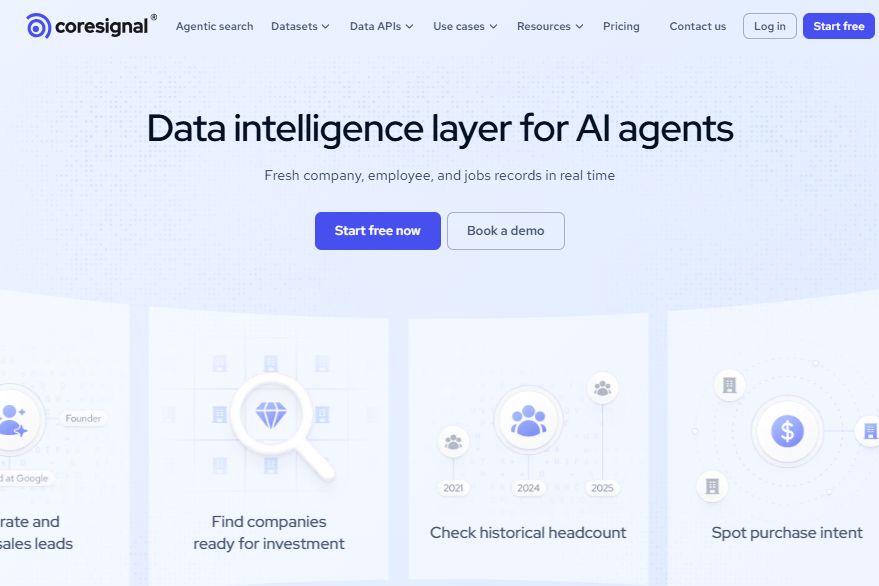
Coresignal sells raw public web data rather than a prospecting app. Company, employee, and job posting records delivered through APIs or bulk datasets. There's no UI for a rep to search. You build the workflow yourself. They publish the rate card, which I appreciate.
Key features
- Large company, employee, and job posting datasets from public web sources
- Company, Employee, and Jobs APIs with Elasticsearch query syntax
- Bulk datasets delivered in Parquet or JSONL to S3, Azure, or Google Cloud
- Agentic Search API for teams building AI agents against B2B data
- Historical data going back to 2016 for trend analysis
- Webhooks and multi-source endpoints on higher tiers
Coresignal's strong points
- Published API pricing across eight tiers, which is rare in this category.
- Historical records support headcount trend analysis rather than a single snapshot.
- Job posting data doubles as a hiring signal on top of static firmographics.
- Bulk delivery fits a warehouse-first architecture without forcing a UI on anyone.
What could be better
- You need engineers. There's no interface a sales team can use directly.
- The gap between the $49 Mini tier and the $199 Starter tier leaves low-volume users squeezed.
- Search-then-enrich patterns bill twice, so a loose query gets expensive fast.
- Bulk dataset contracts run annual with minimums regardless of what you consume.
Pricing
A free trial ships 2,000 credits. Paid API tiers run Mini at $49 a month, Starter at $199, Pro at $499, and Growth at $1,000. Above that sit Premium at $1,500, Scale at $3,000, and Elite at $5,000. Bulk datasets start at $1,000 with contract-negotiated terms. Yearly plans carry a discount.
Final verdict
Coresignal suits a data team building a company data API layer into their own product or warehouse. Hand it to an SDR team and nothing happens.
8. People Data Labs
There's no interface here. People Data Labs ships person and company data through an API and nothing else, priced per successful match. Developers building enrichment into a product choose it. Sales teams do not.
Key features
- Person and company enrichment APIs with per-match billing
- Search API with Elasticsearch DSL and SQL query syntax
- Bulk enrichment up to 100 records per request
- IP enrichment for visitor resolution
- Official SDKs for Python, JavaScript, Ruby, Go, and Rust
- Sandbox endpoints that return synthetic data for testing without spending credits
- Data licensing and feed delivery on Enterprise
Where PDL shines
- Fully published credit tables. You can model cost before writing a line of code.
- Company enrichment prices well below person enrichment, which suits firmographic-only workloads.
- Sandbox endpoints let you build the integration before you spend anything.
- Free tier at 100 lookups a month runs indefinitely rather than expiring after a trial window.
What could be better
- No UI, no CRM connector, no workflow layer. Engineering time is the hidden cost.
- Credits burn on successful matches even when the returned record is sparse.
- Bulk enrichment caps at 100 records per request, which adds orchestration work.
- Enterprise volume pricing turns quote-based and climbs quickly.
Pricing
Free tier at $0 with 100 person or company lookups a month. Pro starts around $98 a month for person data and $100 for company data, with published per-credit tiers that fall as volume rises. Company enrichment starts near $0.10 a credit against $0.28 for person. Enterprise runs custom.
Final verdict
PDL fits teams building B2B data enrichment into their own software. A RevOps lead who needs clean records in Salesforce by Tuesday should look somewhere else.
9. Crunchbase
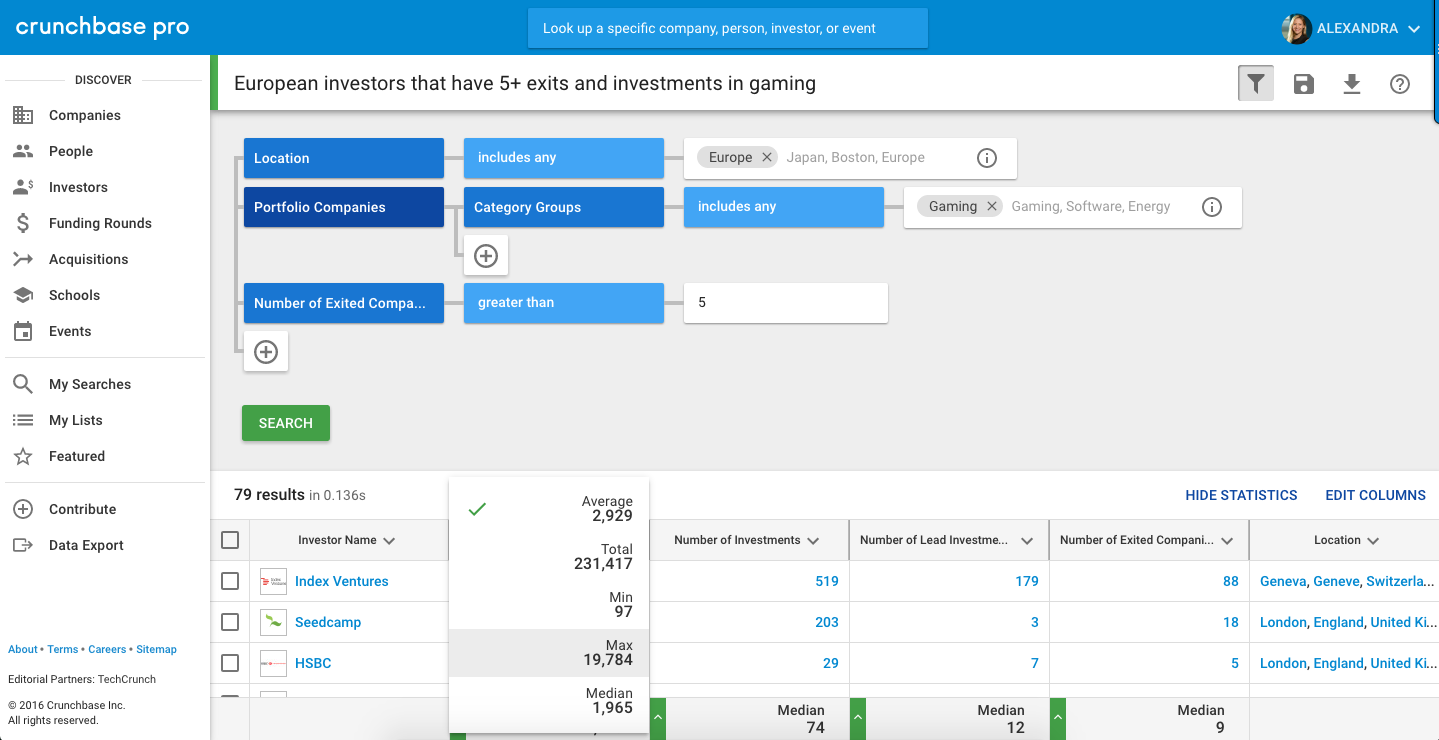
Crunchbase is a company research tool with the best funding data in the category. Private company profiles, funding rounds, investors, acquisitions, and growth signals. The firmographic layer is real but narrower than a full B2B database, and contact data is thin by design.
Key features
- 4M+ private company profiles with funding and investor data
- Funding round history, amounts, stages, and lead investors
- Growth and heat scores that flag momentum
- Saved searches with alerts on funding and news events
- Company similarity and lookalike recommendations
- CRM push to Salesforce and HubSpot on the Business plan
- Chrome extension and API access on higher tiers
What Crunchbase nails
- Funding data is the reference source, and no general B2B provider matches it.
- Alerts on funding rounds surface accounts at the exact moment budget appears.
- Growth signals give you a trajectory rather than a static headcount.
- Pro pricing at $49 a month is accessible for an individual doing account research.
What could be better
- Contact data is thin. Crunchbase researches companies, it doesn't build call lists.
- Export caps bite. Pro allows 2,000 rows a month, which heavy prospecting exhausts.
- CRM integrations require the Business plan at $199 a month per seat.
- Coverage skews toward venture-backed tech. Established private companies in traditional industries get patchy.
Pricing
Free account with limited profile views. Pro at $49 a month billed annually, or $99 billed monthly. Business at $199 a month. Enterprise and API access run custom.
Final verdict
Use Crunchbase alongside a primary data source, not instead of one. If funding-stage targeting drives your ICP it earns a seat, though teams weighing Crunchbase alternatives usually want contact data it was never built to supply.
10. Demandbase
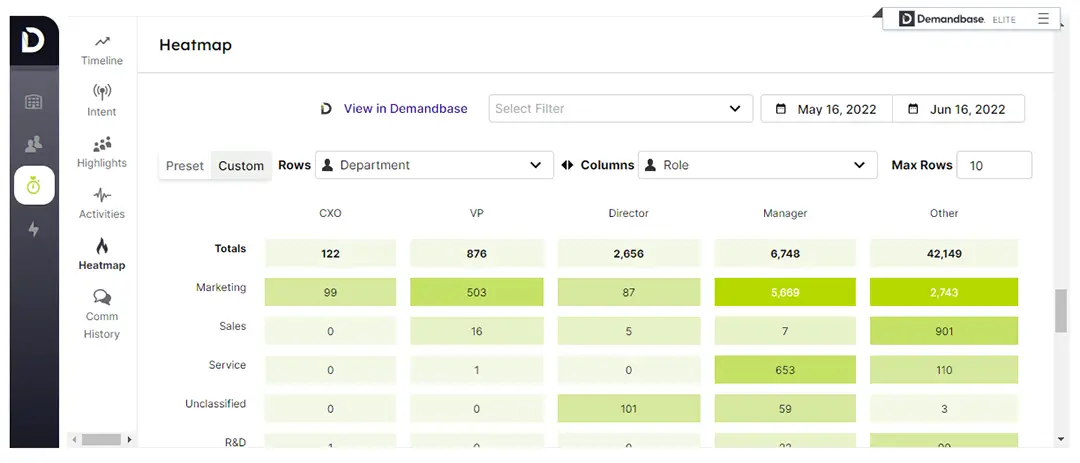
Demandbase wraps firmographic data inside a full account-based platform. Account identification, intent, advertising, web personalisation, and the Sales Intelligence module that absorbed InsideView and DemandMatrix. You're buying a platform, and the data comes along with it.
Key features
- Account identification and firmographic profiles across 100M+ companies
- Intent signals and account-level buying stage prediction
- Sales Intelligence module with buying group identification
- B2B DSP for account-targeted advertising
- Website personalisation by account segment
- Agentbase AI agents for account monitoring and targeting
- Pipeline Predict analytics on the higher tiers
Demandbase's advantages
- Firmographics, intent, and advertising execution operate against the same account list.
- Buying group identification maps a committee rather than handing you a contact.
- The Sales Intelligence layer inherited real firmographic depth from the InsideView acquisition.
- One account list feeds ads, web, and sales at once, which cuts the clean-up work a mature account-based marketing programme usually carries.
What could be better
- Cost. Entry contracts start high and enterprise builds run past six figures.
- No free plan and no self-serve trial. You commit before you test.
- Onboarding fees run separately and land in the tens of thousands.
- Buying it purely for firmographic data is expensive overkill. The platform is the product.
Pricing
No public pricing. Buyer-reported contracts range from roughly $18,000 a year at entry to $300,000 and beyond at enterprise, with mid-market deals clustering between $45,000 and $75,000. Onboarding, extra seats, and add-on modules bill separately.
Final verdict
Demandbase makes sense when ABM is already funded and firmographics are one input among many. Teams shopping purely for company data should compare it against dedicated intent data providers and a standalone data vendor before signing.
How to choose a firmographic data provider for your team
Four paths. The right one depends on where your revenue comes from, not on which vendor prints the biggest number on its homepage.
- Your outbound runs across multiple regions. Coverage outside North America decides it, and vendor claims of "global" rarely survive a sample test. Ask for 200 records in your weakest market and check them yourself. SMARTe and Cognism both survive that test, with SMARTe stronger across LATAM and APAC.
- You sell US enterprise and budget isn't the blocker. ZoomInfo's depth and org chart data earn the spend. Negotiate at quarter end and calendar the renewal window the day you sign.
- You're building on the data, not searching it. Coresignal and People Data Labs hand you raw records and published rates. Budget the engineering time honestly. The invoice is the smaller half of what this costs.
- You're fixing an existing CRM rather than sourcing new accounts. Match rate beats record count here. A vendor with 100M companies and a 40% match rate loses to one with 66M at 90%. Run a sample file first, and CRM data enrichment workflows will tell you what that sample needs to test.
What to do: Pull 500 accounts from your closed-won list, strip the firmographic fields, and send the file to every vendor on your shortlist. Compare match rate and field accuracy against companies you already know. It takes an afternoon and settles arguments no demo can.
Contract terms, refresh promises, and where the data comes from deserve the same checks before the first call. Teams that skip evaluating a B2B data partner properly tend to renew on autopilot for three years.
Where firmographic data breaks and what to do about it
Firmographic fields drift slower than contact fields, which lulls teams into treating them as static. They aren't. What counts as firmographics data never changes. The values sitting in those fields move constantly.
Headcount is the worst offender. A company that laid off 30% in Q1 still shows the old band in half the databases you'd check today. Funding rounds move companies out of your segment overnight. Acquisitions do the same in reverse, folding a perfect-fit target into a parent you already lost to a competitor.
The second problem is subtler. Vendors code industries differently. One reads the website. The other reads the NAICS filing. A vertical SaaS company selling into hospitals might land in "software" with one provider and "healthcare" with another. Your segment sizes won't reconcile, and neither vendor is wrong.
Then there's the subsidiary problem. You target a 200-person company, book the meeting, and find out they're a division of a 40,000-person parent with centralised procurement. Hierarchy data solves this. Few vendors outside D&B carry it well.
Let me qualify that. Hierarchy data solves it when the parent relationship is public. Private equity rollups and holding company structures stay hidden in every dataset I've tested. No vendor admits that in a demo.
Two things fix all three. Continuous verification rather than scheduled refresh, and a workflow that re-enriches accounts before a campaign instead of after. Pairing that with job change tracking catches the contact-side drift at the same time. The mechanics of B2B data decay explain why one-time list purchases stop working inside a quarter.
The part nobody sells you
Every vendor on this list will tell you their data is the cleanest. Some of them are close to right. None of them can tell you which 300 companies out of 40,000 deserve your team's attention this quarter, because that judgement lives with you.
Good firmographic data makes a sharp ICP executable. It doesn't make a vague one work. Teams that win here argue about their segment definition longer than they shop for a vendor. Then they buy the provider whose coverage fits the segment they drew.
Get the definition right first. Then buy the data that serves it.
See how SMARTe's 66M+ company profiles cover your target markets