TL;DR:
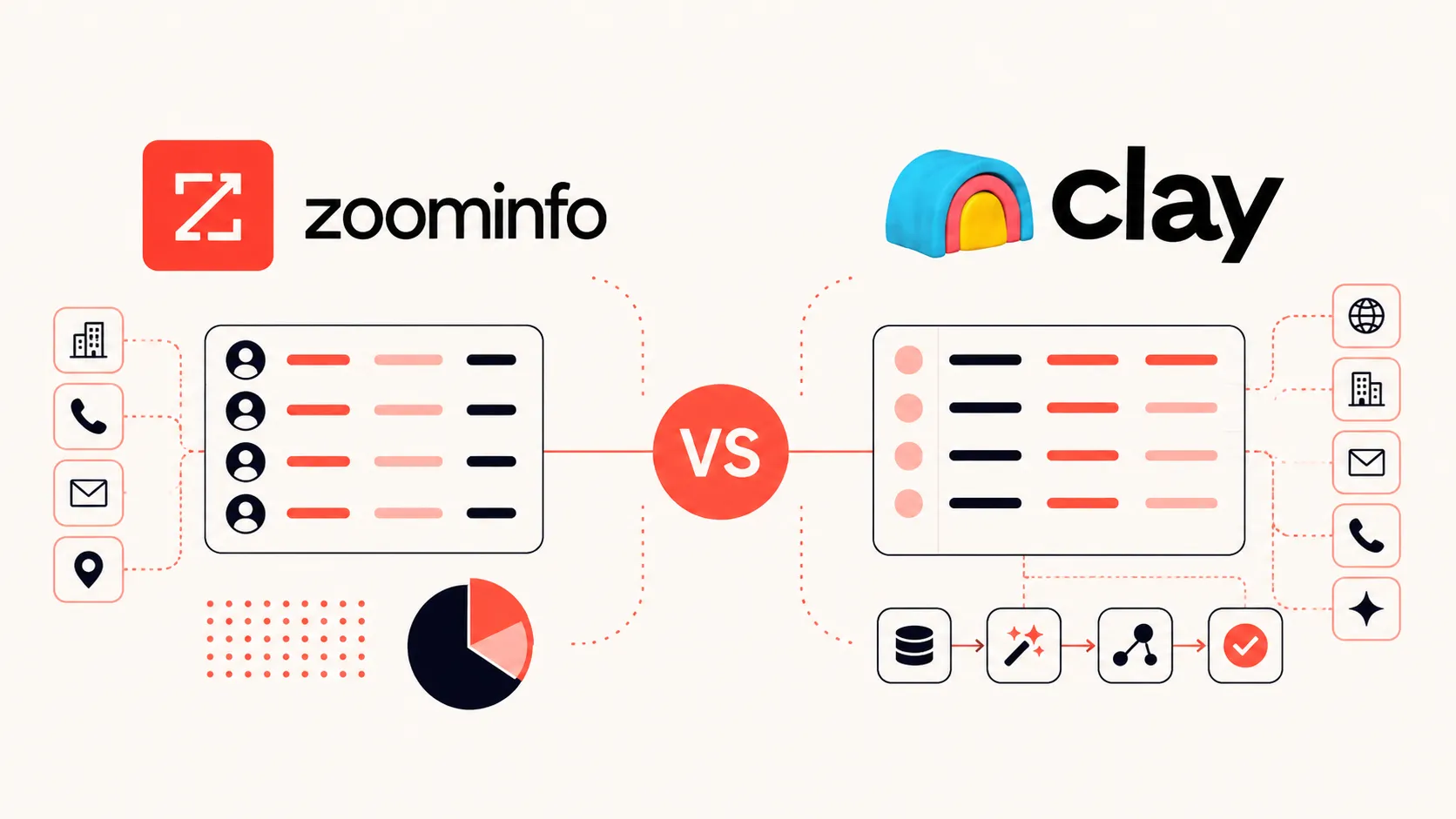
- ZoomInfo vs Clay comes down to who does the work. ZoomInfo gives reps a ready database of 500M+ contacts. Clay gives a builder a workflow that pulls from 200+ providers.
- ZoomInfo now has a free Lite plan and self-serve GTM.AI credits at $0.38 per data credit. Its full rep platform is still sold by quote, and Vendr's median ZoomInfo deal is $33,500 a year.
- Clay is free to start. Launch costs $167 a month and Growth, which adds CRM sync, costs $446 a month (billed annually).
- ZoomInfo is easier for reps and has intent built in. Clay is stronger for custom workflows, AI research and regional coverage.
- Many teams run both: ZoomInfo as the main source and Clay to fill the gaps.
ZoomInfo vs Clay at a glance
ZoomInfo sells its own verified data plus the tools to act on it. Clay sells the workflow and buys data from other providers for you. All vendor facts in this table were checked on November 6, 2026.
How I evaluated ZoomInfo and Clay
I scored ZoomInfo and Clay on the same criteria SMARTe uses for choosing a B2B data provider. I looked at 9 things: data source, coverage, intent, AI, outreach, integrations, usability, compliance and price.
Vendor facts come from each company's pricing pages, product docs and ZoomInfo's AI information page. Review scores come from G2, and deal sizes come from Vendr. Prices change often, so confirm them before you sign.
What is ZoomInfo?
ZoomInfo is an all-in-one go-to-market (GTM) platform built on its own B2B database. ZoomInfo reports 500M+ contacts, 100M+ companies and 135M+ verified phone numbers. It says 300+ human researchers and machine learning keep those records current.
ZoomInfo launched or renamed most of its products in 2025 and 2026. Its product facts page, updated October 2026, lists this lineup:
- GTM Workspace: the AI workspace for sellers, with AI agents for account research, meeting prep and deal priority. ZoomInfo Copilot now runs inside it and isn't sold separately.
- GTM Studio: the ops workspace for plays, audiences and waterfall enrichment from 25+ sources, built in plain language.
- Agent Teams: groups of AI agents in GTM Studio that run full GTM plays within the approval limits you set. Launched October 2026.
- GTM Context Graph: the layer that joins ZoomInfo data with your CRM records, conversation intelligence and buying signals.
- GTM.AI: a self-serve data enrichment API, CLI and MCP server for developers and AI agents.
- ZoomInfo Lite: a permanent free plan.
What is Clay?
Clay is a spreadsheet-style data orchestration tool for GTM teams. Clay has no verified contact database of its own. Instead, it pulls emails, phone numbers and company data from 200+ outside providers on one contract. For list building, Clay keeps an index of people, companies and jobs as a starting point.
Each Clay table is a workflow, and every column runs one step. One column might find a work email, the next might score the lead, and a third might write a first line with AI. The main parts of Clay are:
- Waterfall enrichment: Clay asks providers one at a time, in the order you set, until one returns a valid result.
- Claygent: an AI agent that researches each row on the web and returns structured answers.
- Sculptor: an AI copilot that builds workflows from a plain-language prompt.
- Signals: job changes, funding, tech stack changes, web visits and social mentions.
- Sequencer: native cold email, live since September 2026 on paid plans.
- Audiences and Ads: list building plus ad audience sync to LinkedIn, Meta and Google.
- Clay MCP: access to Clay data from AI assistants.
Clay changed its pricing on March 11, 2026, splitting one credit into two. Data credits pay for marketplace data, and actions pay for platform work. Clay says the change cut the cost of its most-used enrichments by 50 to 90%.
ZoomInfo vs Clay: 8 differences that decide the choice
ZoomInfo and Clay differ most in where the data comes from. These 8 points usually decide the purchase.
1. Data model: owned database vs multi-source waterfall
ZoomInfo owns its data. Clay pays other providers for each lookup, so you do more of the setup and your bill tracks how many lookups you run.
With ZoomInfo, a rep filters by title, company size or tech stack and exports a list from records ZoomInfo already holds. ZoomInfo says GTM Studio enrichment runs a waterfall that checks 25+ extra sources at once and keeps the highest-confidence match.
With Clay, you build the pipeline yourself. Clay runs providers in sequence and stops at the first valid result. You decide which providers run, in what order and under what conditions.
Diagram comparing ZoomInfo's single owned database with Clay's waterfall across many data providers
My take: if one database already covers most of your target list, buy the database. If it keeps missing whole segments, the waterfall is worth the setup time.
2. Data coverage and accuracy
ZoomInfo has more verified data in one place, though Clay can often fill more of a hard list because it queries many sources.
ZoomInfo reports 200M+ verified business emails and 135M+ verified phone numbers. Treat those as vendor figures. Even a large database runs thin on small firms, niche industries and non-English markets, so test those segments first.
Clay's data enrichment is only as accurate as the providers you pick. If a provider returns a bad email, Clay passes it through unless you add a verification step to the table.
Phone numbers and direct dials
ZoomInfo is the stronger pick for US direct dials (numbers that ring one person directly) inside a single tool. Mobile numbers come on its base Professional plan.
In Clay, phone enrichment starts on the Launch plan. Your hit rate depends on which phone providers sit in your waterfall.
Judge phone data by connects. A number that rings the front desk still counts as "found" in both tools, so a high find rate can hide a low connect rate.
Coverage outside North America
Clay has the edge for international lists because you can add regional providers. ZoomInfo's own product page tells teams that sell only into one non-North-American market to test regional coverage first. In Clay, you can run a Europe-focused provider first for German accounts and a US-focused one first for Texas.
3. Intent data and buying signals
ZoomInfo is the better pick for packaged intent data. Clay is better when you need a signal no vendor sells.
ZoomInfo's intent data comes in several forms:
- Streaming Intent, an add-on priced by keyword volume and account universe
- WebSights, which shows the companies visiting your website
- Marketing plans with 25 intent topics (Marketing Demand), 100 (ABM Lite) or unlimited topics (ABM Enterprise)
ZoomInfo also says Forrester named it a Leader in its Wave for B2B intent data providers in Q1 2025.
Clay has no single intent dataset of its own. Job change, news and social signals come with Launch, and web intent comes with Growth. You can also build your own signals for signal-based GTM. For example, Claygent can flag a target account that posts a RevOps job and adds a competitor's tool in the same month.
4. AI agents and workflow automation
Clay suits teams that want to build their own automation. ZoomInfo is closer to done-for-you, with AI agents that run plays.
In Clay, Claygent researches rows on the web and Sculptor drafts workflows from a prompt. Clay Workflows handle GTM workflow automation with branching and code. You can also pick AI models from OpenAI, Anthropic and Google.
ZoomInfo's AI runs on the GTM Context Graph. Agent Teams build plays from plain-English prompts and run them end to end. ZoomInfo's own example enriches new CRM accounts, scores them for intent and routes the best fits into SDR sequences. GTM Workspace gives reps AI account research and meeting prep.
Agent Teams launched in October 2026. Ask for a live demo on one of your own plays before you pay for it.
5. Outreach and execution
ZoomInfo covers more of the sales motion inside its own product. According to ZoomInfo, GTM Studio runs plays with CRM sync, account routing, ad audiences and sequence triggers. ZoomInfo Engage adds email sequences and an auto-dialer.
Clay covers cold email through Clay Sequencer, which runs on Smartlead and allows up to 4 emails per sequence. Sequencer skips dialing and LinkedIn steps, so most Clay teams still push data into Outreach, Salesloft or HubSpot for calls and multichannel sales cadences. Neither tool replaces your CRM. Both need Salesforce or HubSpot as the system of record.
6. Integrations, API and MCP
ZoomInfo and Clay both connect to the major CRMs, and both now offer servers built on the Model Context Protocol (MCP) for AI assistants.
ZoomInfo has native Salesforce, HubSpot, Outreach and Salesloft integrations. GTM.AI adds API, CLI and MCP access to ZoomInfo data.
Clay syncs with Salesforce and HubSpot and connects to Outreach, Salesloft, Smartlead and data warehouses. On Clay, CRM sync, the HTTP API and webhooks all need the Growth plan.
7. Ease of use and the people you need
ZoomInfo is easier for reps to pick up, while Clay needs someone to own it. G2's comparison page shows the same gap (scores as of November 2026):
Clay's biggest cost is the person who runs it. That person manages API keys, conditional runs, AI prompts and credit budgets. It's the job a GTM engineer does. If they leave and nobody documented the tables, workflows can break without anyone noticing.
ZoomInfo needs an admin too, for seats, intent topics and CRM field mapping, but that's a lighter job.
My rule: if you can't name the person who will own Clay for the next 12 months, buy a database.
8. Compliance and data rights
ZoomInfo is simpler to review for compliance because its core database comes from one vendor.
ZoomInfo lists GDPR, CCPA, SOC 2 Type II, ISO 27001, ISO 27701 and TRUSTe. Clay lists SOC 2 Type II, GDPR, CCPA, ISO 27001 and ISO 42001.
With Clay, each provider in your waterfall sourced its records under its own terms. Ask your legal team to review Clay and every provider you turn on. The same applies to any extra sources you switch on in ZoomInfo's GTM Studio waterfall.
ZoomInfo vs Clay pricing in 2026
Clay is cheaper to start and you can buy it online. ZoomInfo now has free and self-serve options too, but its full rep platform is still sold by quote.
ZoomInfo pricing
ZoomInfo now sells in 3 ways:
- ZoomInfo Lite: free forever, with 10 credits a month, no card and no contract.
- GTM.AI: self-serve credits with no seats and no contract. As of November 2026, the GTM.AI pricing page lists data credits at $0.38 each at the $1,000 tier and AI credits at $0.05. New accounts get 1,000 of each free, and credits expire after 12 months.
- Platform plans: Professional, Copilot Advanced, Copilot Enterprise and the marketing plans are quoted by sales. ZoomInfo pricing for these plans depends on features, licenses and credits. Most paid plans are annual and billed up front.
On platform plans, each export costs one credit. Streaming Intent is priced on top.
Vendr's ZoomInfo data shows a median deal of $33,500 a year across 1,580 purchases. The range runs from $7,260 to $156,011.
Clay pricing
Clay publishes all of its self-serve prices. These are the plans on Clay's pricing page as of November 2026:
A few details change the math:
- Clay University says a fully enriched record usually costs 6 to 20 data credits.
- Data credits start at $0.05, and top-ups cost 30% more than plan credits.
- You pay nothing when an enrichment returns no result.
- If you bring your own API key, you skip data credits for that provider.
- Seats are unlimited on every plan.
Vendr shows a median Clay contract of $60,210 a year across 101 purchases. That's above the $33,500 ZoomInfo median, so price Clay at your real volume before you assume it's cheaper.
What 10,000 enriched records cost on each
Enriching 10,000 records costs roughly $3,800 to $11,700 a year at list prices, depending on whether you use ZoomInfo GTM.AI or Clay Growth and how much data you pull. Here's the illustrative math for 10,000 contacts a year, synced to Salesforce.
Clay needs the Growth plan for CRM sync. At 6 credits per record, 60,000 credits fit the base Growth plan at $446 a month. At 20 credits per record, you need 200,000 credits, which means the 240,000-credit tier at about $977 a month with base actions.
ZoomInfo's GTM.AI charges one data credit per record, so 10,000 records cost about $3,800 at the listed rate. GTM.AI is an API, though, so someone still has to build the CRM sync.
Bar chart of illustrative yearly cost to enrich 10,000 records with Clay Growth and ZoomInfo GTM.AI
Per record, raw data costs land in a similar range on both sides. The bigger differences are the interface and the labor. With Clay, you pay for the tooling and supply the builder yourself. ZoomInfo's platform price covers the rep app and intent data.
5 contract terms to check before you sign
Check these terms before you sign either tool:
- Renewal notice. Vendr says ZoomInfo notice periods are often 30 to 90 days. Put the date in your calendar the day you sign.
- Price increases. Vendr reports yearly escalators of 5 to 10% in many ZoomInfo contracts. Ask for a cap in writing.
- Credit expiry. GTM.AI credits expire after 12 months. Clay's actions reset each billing cycle, while data credits roll over within plan limits.
- Data after you leave. ZoomInfo's own pricing guide tells buyers to ask what happens to exported data if they don't renew. Ask Clay the same about your tables.
- Discount room. G2 lists an average discount of 15% for ZoomInfo and 6% for Clay.
ZoomInfo vs Clay pros and cons
ZoomInfo's biggest pro is ready data, and its biggest con is the annual contract. Clay flips that. You get control and flexible billing, and you pay for it in setup work.
ZoomInfo pros and cons
ZoomInfo pros:
- Large owned database with direct dials, ready to search right away
- Built-in intent, website visitor data and account-based marketing plans
- Easier for reps, with an 8.8 usability score on G2
- One vendor and one contract to review
ZoomInfo cons:
- Full platform is quote-based, with annual terms
- Weaker fit for teams selling into a single market outside North America, by ZoomInfo's own guidance
- Intent and some tools cost extra
- Every export spends a credit
If ZoomInfo isn't the right fit, compare these ZoomInfo alternatives or read the full ZoomInfo review.
Clay pros and cons
Clay pros:
- 200+ providers in one waterfall, in the order you choose
- Claygent and AI formulas for research no database covers
- Free plan, monthly billing and unlimited seats
- Native email Sequencer on paid plans
Clay cons:
- Needs a technical owner, and scores 7.8 for usability on G2
- Data quality depends on the providers you pick
- No built-in intent dataset and no dialer
- CRM sync needs the $446-a-month Growth plan
If Clay isn't the right fit, compare these Clay alternatives or read the full Clay review.
ZoomInfo or Clay: which should you choose?
Two questions settle it for most teams: who will do the prospecting, and where your buyers are.
Choose ZoomInfo if
Choose ZoomInfo if most of these sound like your team:
- You want an all-in-one platform with instant coverage, direct dials and built-in intent
- Your reps aren't technical and need to prospect from week one
- Most of your buyers are in North America
- You want one contract and one compliance review
Choose Clay if
Clay is the better fit when you can say yes to most of these:
- You have RevOps or GTM engineering talent on the team
- You want custom multi-source enrichment and web scraping logic
- You'd rather pay for usage than sign a locked annual contract
- You sell into niche markets or several regions
Choose neither if
Skip both if your problem sits downstream of the data. A data tool won't fix bad CRM data like duplicate records, broken lead routing or reps who don't log activity. If you need verified emails for a few hundred contacts a month, both tools are more than the job needs.
Quick picks by team type
ZoomInfo or Clay often comes down to team shape. These are my picks for 7 common setups:
Can you use ZoomInfo and Clay together?
Yes, and many advanced teams do. They use ZoomInfo as the verified base and Clay as the orchestration layer on top.
Clay has a native ZoomInfo integration, but you connect your own ZoomInfo account with API access. You can't buy ZoomInfo data with Clay data credits. Once connected, Clay can:
- Enrich companies with revenue, competitors and company hierarchy
- Enrich contacts from an email address, or from a name plus company
A common setup puts ZoomInfo first in the Clay waterfall and lets other providers fill the gaps. You pay twice in that setup: each ZoomInfo lookup draws on your ZoomInfo contract, and each Clay step costs actions.
At renewal, check who still logs in to ZoomInfo. If Clay does all the work, price the providers that would replace it. Start with ZoomInfo vs SMARTe for global mobile data, or Cognism vs ZoomInfo if most of your buyers are in Europe.
How to test ZoomInfo and Clay before you sign
Run a 2-week test on your own records before you sign either contract. Track cost per usable record, meaning a valid email or a connected number.
- Pull a sample. Take 100 recent closed-won contacts, 100 open-deal contacts and 100 target accounts in your hardest region.
- Strip the contact fields. Remove emails and phones. Keep name, company and domain.
- Run both tools. Use ZoomInfo Lite, GTM.AI's free credits or a ZoomInfo trial. In Clay, build a waterfall on the 14-day trial.
- Check emails. Compare found emails with the ones you removed. Run the rest through email verification before you send anything.
- Dial. Call 50 numbers from each list and log connects to the right person.
- Add up the cost. Count credits, plan fees and the hours your ops person spent building.
- Divide. Split total cost by usable records.
Then score the results. These are my suggested weights:
Raise the phone weight if your team leans on cold calling. Raise setup time if nobody has spare ops hours.
Is there a third option? Where SMARTe fits
SMARTe fits if you want a database like ZoomInfo at a lower price, with more mobile numbers outside the US. Since SMARTe makes a product in this category, weigh this section with that in mind.
SMARTe is a B2B data and sales intelligence platform. Its data covers 285M+ contacts and 66M+ companies across 200+ countries, and SMARTe reports these figures:
- 75% of North American contacts come with mobile numbers
- About half of the international database is mobile-ready
- 95% email accuracy and 98% company data accuracy
Reps get the data through the SMARTe Chrome extension and native Salesforce, HubSpot, Outreach and Salesloft integrations. Bombora intent data sits in the same platform. On compliance, SMARTe is SOC 2 Type II certified, GDPR aligned and CCPA compliant.
The SMARTe Enterprise plan starts at $15,000 a year. SMARTe says that's about half the cost of ZoomInfo, and Vendr puts the median ZoomInfo deal at $33,500.
SMARTe also works natively inside Clay, on Clay's shared API key or your own SMARTe account. That lets you run it as a mobile and global source in a Clay waterfall. Two limits: SMARTe is a single data source, so it won't replace a multi-vendor waterfall, and it has no self-serve plan.
If you're running a 300-record test and want SMARTe in it, book a SMARTe demo. It's a no-commitment walkthrough built around your use case, so bring your hardest region and the accounts ZoomInfo or Clay keep missing.
My verdict on ZoomInfo vs Clay
I'd buy ZoomInfo when reps do their own prospecting and need data they can trust without a builder. Cap the escalator and put the renewal date in your calendar. I'd buy Clay when an ops builder runs the motion, because a well-built Clay waterfall can fill more of a hard list and run plays ZoomInfo can't.
My prediction: the gap between them keeps shrinking. ZoomInfo now sells waterfalls, free credits and an MCP server. Clay now sends email and keeps adding signals. Within a year, I expect buyers to ask whose data sits at the top of their waterfall.
Start with the 300-record test. Then put both quotes next to SMARTe pricing.